In the final days before Christmas 2025, while Washington emptied out and the language of the season turned toward peace and goodwill, a very different document landed quietly inside the White House complex. It was a legal memorandum from the Department of Justice’s Office of Legal Counsel addressed to the National Security Council. Its subject was not diplomacy. It was not sanctions. It was not negotiation.
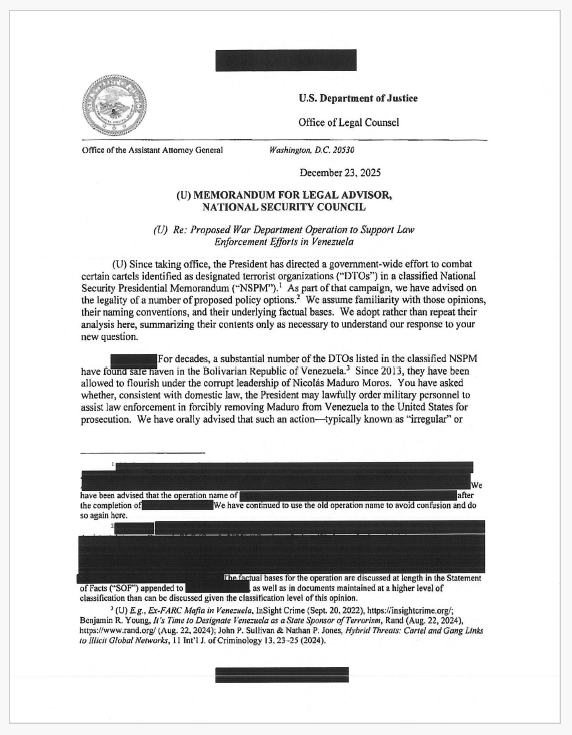
It asked whether the President of the United States could lawfully order American forces to enter Venezuela, seize Nicolás Maduro, and bring him to the United States to stand trial.
The memo is dense, cautious, and heavily redacted, but its purpose is unmistakable. This was not an abstract exercise in constitutional law. It was a rehearsal. The document does not command action, but it clears a path, outlining how such an operation could be justified under U.S. law, international law, and decades of precedent if the President chose to act.
The Office of Legal Counsel occupies a peculiar place in American government. It is not a court, but its opinions often carry the force of one inside the executive branch. When presidents push against the outer edge of their authority, OLC is where they go to learn how far the law will bend before it breaks. The memos it produces rarely see daylight. When they do, as with the torture opinions of the early 2000s or the surveillance memoranda revealed by Edward Snowden, they tend to reshape public understanding of how power actually operates.
This memo belongs to that tradition.
At its core, the document reframes Nicolás Maduro not primarily as a foreign head of state, but as the leader of what it characterizes as a criminal enterprise embedded within the Venezuelan government. Drawing on prior U.S. indictments, intelligence assessments, and public reporting, the memo describes a regime intertwined with narcotics trafficking networks, including long alleged links to the FARC and to Hezbollah-associated facilitators. The distinction is crucial. Under international norms, forcibly seizing a sitting head of state is an act that would typically be indistinguishable from war. But seizing the leader of a transnational criminal organization, even one who happens to control a government, opens a different legal door.
That door is what the memo spends twenty pages trying to unlock.
The operation it evaluates is carefully described as limited, precise, and temporary. U.S. forces would enter Venezuelan territory for the sole purpose of capturing Maduro. The objective would be arrest, not assassination. There would be no occupation, no attempt at regime change, no sustained campaign. Maduro would be transported to the United States to face prosecution under existing criminal indictments. The operation would conclude as quickly as it began.
The memo insists, repeatedly, that this distinction matters. Under the Constitution, Congress declares war, but presidents have long claimed authority to use force short of war to protect national interests. The document argues that this proposed operation would fall into that gray space. It would be violent and risky, but not a war in the constitutional sense. It would resemble a law-enforcement action supported by military force rather than a traditional act of armed conflict.
International law presents a harder problem, and the memo does not pretend otherwise. Sending armed forces into another sovereign nation without consent violates the core principle of territorial integrity. The memo acknowledges this directly, then builds its case for why the violation might nevertheless be lawful. It invokes self-defense, arguing that Maduro’s activities constitute an ongoing threat to U.S. security. It invokes necessity, asserting that Venezuela is unwilling or unable to neutralize that threat itself. It invokes proportionality, stressing that the operation would be narrowly tailored. And it invokes precedent, leaning heavily on the long and uncomfortable history of the United States seizing suspects abroad and prosecuting them at home.
That history stretches back decades.
In 1960, Israeli agents abducted Adolf Eichmann from Argentina and transported him to Jerusalem to stand trial for crimes against humanity. The operation provoked international outrage, but Eichmann was tried and executed nonetheless. The precedent reverberated.
In 1989, U.S. forces invaded Panama and captured Manuel Noriega, a sitting head of state who had been indicted in the United States on drug trafficking charges. Noriega was brought to Florida, tried, convicted, and imprisoned. The courts rejected arguments that his capture barred prosecution.
In 1997, FBI agents lured Mir Aimal Kansi, who had murdered CIA employees outside agency headquarters, out of Pakistan and transported him to the United States. He was tried and executed.
In 2014, U.S. agents arrested Joaquín “El Chapo” Guzmán in Mexico, later extraditing him to New York, where he was sentenced to life in prison.
Again and again, American courts have upheld a blunt doctrine. How a defendant arrives in U.S. custody does not, by itself, deprive a court of jurisdiction. The memo relies heavily on that principle. Even if Maduro’s seizure were deemed unlawful under international law, it argues, U.S. courts would still be permitted to try him.
The document does not minimize the risks. It outlines the likelihood of Venezuelan military resistance, the danger to civilians, the possibility of retaliation against U.S. interests, and the chance that a failed operation could escalate into a broader conflict. It concedes that Maduro would almost certainly not surrender voluntarily and that intelligence gaps could prove fatal. The legal analysis does not erase these realities. It merely insists that danger is not the same as illegality.
What makes the memo unsettling is not its tone, which is measured and technical, but its implications. It asserts that under certain conditions, the President may order military force without congressional authorization, deploy that force to support criminal law enforcement, violate another nation’s sovereignty, seize its leader, and deliver him to an American courtroom. All without a declaration of war.
The memo attempts to confine this authority within strict factual and legal limits. But once articulated, such limits have a way of expanding. Power justified in one case rarely stays there.
Most Americans will never read this memo. Fewer still will be told that such questions were seriously analyzed at the highest levels of government. Yet it offers a rare glimpse behind the curtain, showing how the United States prepares for extraordinary acts long before the public is asked to judge them.
Law, the document reminds us, is not merely a brake on power. It is also the mechanism by which power is made usable.
Sometimes, quietly, it even makes the unthinkable plausible.
If the December 2025 Office of Legal Counsel memo reads like a carefully staged rehearsal, the Supreme Court is the audience it cannot fully control.
Inside the executive branch, the document builds a confident case that the President could lawfully order the capture of Nicolás Maduro and bring him to the United States for trial. It marshals precedent, doctrine, and decades of executive practice. It anticipates objections and attempts to defang them. On paper, the reasoning is tight. In court, however, paper is never enough.
The Supreme Court has long tolerated expansive presidential authority in foreign affairs, but it has also grown increasingly skeptical of unilateral executive power when constitutional boundaries are pressed too far. The question is not whether the Court has ever allowed something like this before. It has. The question is whether it would still do so now.
The memo’s strongest argument rests on jurisdiction. American courts have repeatedly held that the manner in which a defendant is brought before them does not defeat their authority to try him. This principle, rooted in cases like Ker v. Illinois and Frisbie v. Collins, has survived for more than a century. Even when captures violated international law or foreign sovereignty, the Court declined to intervene. The memo leans heavily on this line of cases, and on its face, that reliance is well founded.
But jurisdiction is only one piece of the puzzle. The harder question is whether the President has constitutional authority to order such a capture in the first place.
Here the memo walks onto shakier ground.
The executive branch has traditionally argued that the President may use force abroad without congressional authorization so long as the action does not rise to the level of war. That standard has never been crisply defined, and the Court has largely avoided doing so. In cases involving Korea, Vietnam, Libya, and post 9/11 counterterrorism operations, the justices have preferred ambiguity to confrontation.
Yet ambiguity cuts both ways. A forcible incursion into Venezuela to seize a sitting head of state, even for criminal prosecution, would be unprecedented in its legal framing if not in its mechanics. The Court could plausibly conclude that such an operation exceeds the President’s Article II authority by effectively initiating hostilities against another sovereign without congressional consent.
The memo attempts to preempt this by characterizing the operation as law enforcement rather than war. That distinction may persuade executive lawyers, but it is unlikely to fully persuade the Court. Justices have shown growing impatience with semantic maneuvering that masks substantive exercises of power. In recent years, the Court has rejected agency attempts to reclassify major actions in order to avoid constitutional scrutiny. A similar instinct could apply here.
There is also the question of international law, which the memo treats as relevant but not binding. Historically, the Court has been reluctant to invalidate executive action solely on the basis of international law violations. But that reluctance is not absolute. Several justices have signaled concern when international norms are dismissed entirely, particularly when doing so risks entangling the United States in prolonged conflict.
A capture operation that violates Venezuelan sovereignty could invite retaliation, escalation, or regional instability. The Court may ask whether the President can unilaterally assume such risks without congressional authorization. That inquiry would not be abstract. It would be grounded in the Constitution’s allocation of war powers.
The most vulnerable aspect of the memo, however, may be its reliance on historical practice. The document points to past extraterritorial captures as evidence of legality. But the Court has increasingly questioned the idea that repetition alone can constitutionalize executive action. In cases involving surveillance, detention, and administrative authority, the justices have pushed back against the argument that long standing practice equals lawful power.
The current Court is also far more skeptical of executive branch self certification. OLC opinions carry weight inside the government, but they carry none inside the judiciary. Several justices have openly criticized the executive branch for acting as judge of its own authority, particularly in matters involving national security.
If a case arising from such an operation reached the Supreme Court, the justices would likely ask not only whether the President could act, but whether Congress had meaningfully acquiesced. Silence may no longer be enough. The War Powers Resolution, imperfect as it is, reflects congressional intent to restrain unilateral military action. The Court could interpret a capture operation of this magnitude as precisely the kind of scenario the Constitution reserves for legislative involvement.
None of this guarantees that the memo’s reasoning would fail. The Court could choose deference. It could invoke the political question doctrine. It could decline to hear the case at all. But unlike in earlier eras, those outcomes would no longer be automatic.
The December memo assumes a legal environment shaped by decades of post Cold War executive dominance. The Supreme Court that would review it is increasingly interested in reclaiming constitutional boundaries that dominance eroded.
The irony is that the memo may be both legally sophisticated and judicially vulnerable at the same time. It is carefully constructed to survive internal review, but it depends on doctrines the Court has begun to reconsider.
In the end, the question is not whether the President could order such an operation. It is whether the Constitution would still recognize it as lawful once the smoke cleared and the case file landed on One First Street.
That is a question no memo can answer in advance.