



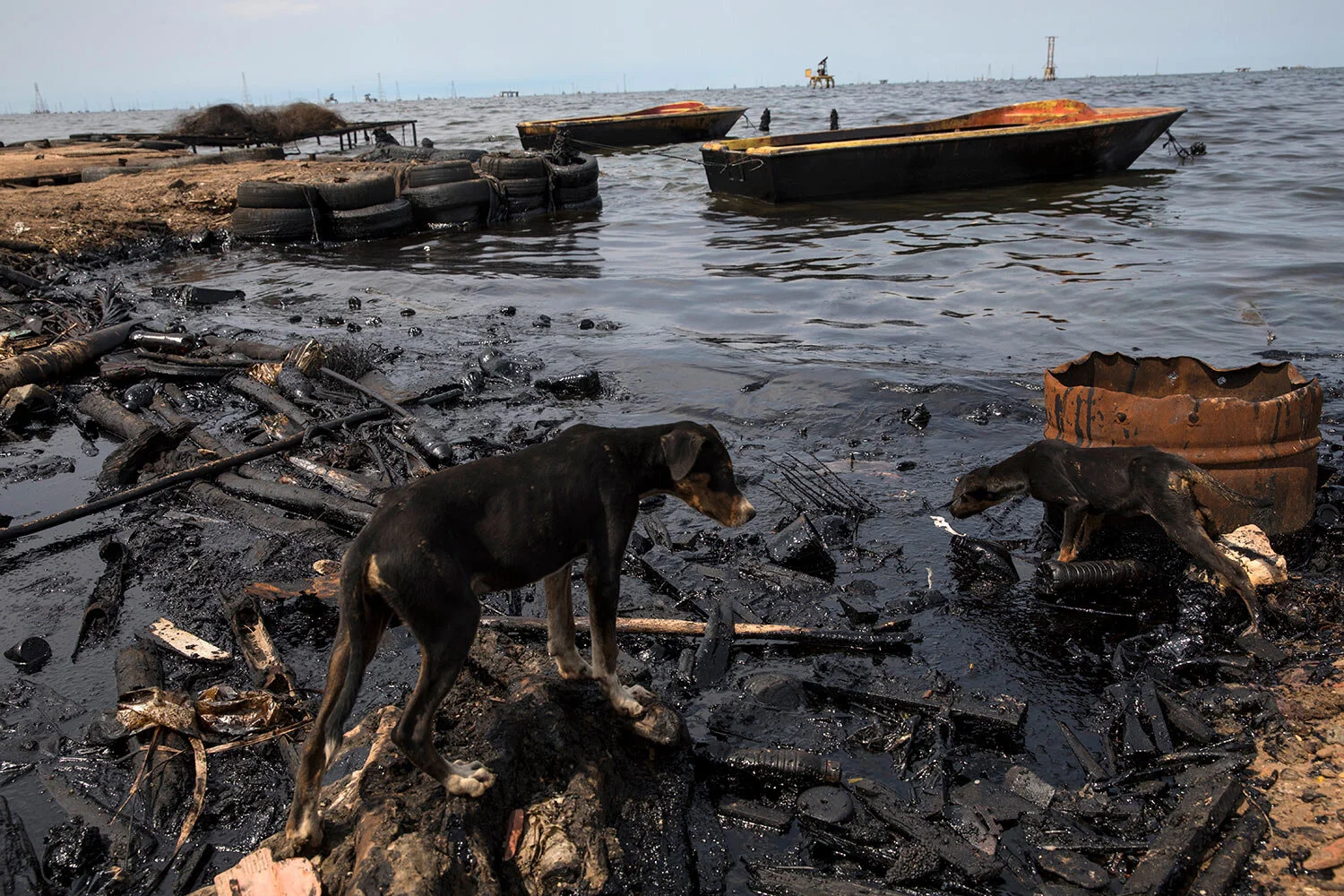
Dogs search for scraps of fish left behind by fishermen on the shore of Lake Maracaibo blacked by oil, near La Salina crude oil shipping terminal in Cabimas, Venezuela. (AP Photo/Rodrigo Abd)
If 1976 was Venezuela’s gentlemanly seizure, the decades that followed were something else entirely: a hesitant reopening to the world, followed by a politicized reversal, and finally a slow institutional collapse under authoritarian rule. The story of Venezuelan oil after nationalization is not a straight line from sovereignty to ruin. It is a pendulum, swinging between pragmatism and ideology, competence and purges, contracts and confiscation. And it is in this second act, not the first, that modern claims of “theft” find their firmest footing.
To collapse these phases into a single narrative is to misunderstand not only Venezuela’s history, but the conditions under which resource sovereignty succeeds or fails.
The Hangover: The 1980s and the Limits of Sovereignty
Nationalization delivered control, but not immunity. By the early 1980s, Venezuela was discovering an uncomfortable truth: owning oil and monetizing it are distinct skills. Petróleos de Venezuela, S.A. (PDVSA), staffed largely by the same engineers and managers who had once worked for Exxon, Shell, and Gulf, initially performed admirably. It operated with unusual autonomy for a state oil company, expanded refining capacity abroad, and cultivated a technocratic culture that drew quiet admiration across Latin America.
Then the oil price collapsed.
The 1980s debt crisis exposed the fragility beneath the surface. Easy petrodollars from the 1970s evaporated as global interest rates spiked and capital retreated from emerging markets. The Venezuelan state leaned ever more heavily on PDVSA to fund budgets, service foreign debt, and compensate for deeper structural weaknesses. Investment slipped. Maintenance was deferred. The system still functioned, but its margins narrowed, and its vulnerabilities deepened.
The most stubborn of those vulnerabilities lay in the Orinoco Belt. The hydrocarbons were vast but difficult: heavy, sulfur-laden crude that required expensive upgraders and specialized expertise to make it marketable. PDVSA could not develop the Orinoco alone at scale, not while simultaneously serving as the state’s fiscal shock absorber.
Sovereignty had been secured. Sustainability had not.
The Apertura: A Quiet Reversal of 1976
The response in the 1990s was pragmatic and controversial. Under Carlos Andrés Pérez and later Rafael Caldera, Venezuela launched the apertura petrolera, reopening parts of its oil sector to foreign capital without formally relinquishing national ownership. The language was carefully chosen. This was not privatization. It was “strategic association.”
Foreign firms were invited back into upstream projects, particularly in the Orinoco, through joint ventures that offered operational control and favorable fiscal terms in exchange for massive capital investment. Royalties were reduced, tax regimes softened, and stability clauses promised predictability. The signal to global markets was unmistakable: Venezuela still owned the oil, but it needed partners to extract its value.
Projects such as Petrozuata, Hamaca, Cerro Negro, and Sincor rose rapidly from scrubland into industrial complexes, complete with pipelines, ports, and billion-dollar upgraders. Production recovered. Output climbed. By the late 1990s, the apertura appeared, on paper, to be working.
To critics, however, it looked like capitulation. The country that had nationalized its oil with pride now seemed to be creeping backward, offering foreign firms generous terms and ceding control in all but name. PDVSA’s effective revenue share shrank under these arrangements, sharpening the sense that sovereignty had been diluted rather than strengthened. The pendulum had swung toward pragmatism, but public confidence had not followed.
Chávez: When Oil Became a Weapon
Hugo Chávez was elected in 1998 amid this discontent. To him, PDVSA was not a national champion but a “state within the state,” governed by engineers who thought like multinationals and insulated themselves from democratic control. Oil, in Chávez’s vision, was not merely an industry. It was the engine of a political project.
The early years were deceptively moderate. Existing contracts remained in force. Foreign firms stayed. But the direction was clear. The 2001 hydrocarbons law raised royalties, strengthened state control, and subordinated PDVSA to political priorities. Social spending expanded. Professional autonomy eroded. Loyalty increasingly trumped expertise.
The decisive break came with the 2002–2003 oil strike. When PDVSA employees joined a broader shutdown aimed at forcing Chávez from power, he responded with a purge of historic scale. Tens of thousands of workers were dismissed, including much of the company’s senior technical and managerial talent. Institutional memory walked out the door. Politics moved in.
A surge in global oil prices soon obscured the damage. With crude selling for multiples of its late-1990s price, Chávez turned decisively against the apertura itself. His argument was not entirely unsound. Venezuela had negotiated from weakness when prices were low. The problem lay not in the diagnosis, but in the remedy.
2007: From Renegotiation to Expropriation
In 2007, Chávez ordered all Orinoco projects converted into empresas mixtas, with PDVSA holding a controlling stake. Most foreign firms complied, accepting harsher terms to preserve access. Two did not. ExxonMobil and ConocoPhillips refused, citing contractual guarantees and international investment treaties.
The state seized their assets.
This was not 1976. There were no extended negotiations, no carefully structured compensation frameworks, no sustained effort to preserve investor confidence. Venezuela offered compensation based largely on depreciated book value. The companies demanded fair market value. The dispute migrated from Caracas to international arbitration.
Tribunals later affirmed Venezuela’s sovereign right to nationalize, but ruled unequivocally that it had failed to provide adequate compensation. Multi-billion-dollar awards followed. Whatever one’s view of multinational oil firms, the legal conclusion was clear. This was unlawful expropriation.
It is here, not in the orderly nationalization of the 1970s, that modern claims of “theft” are properly anchored.
The Maduro Era: Collapse Without Illusion
Nicolás Maduro inherited Chávez’s system stripped of its advantages. Oil prices fell. Sanctions tightened. Corruption metastasized. PDVSA, hollowed out by purges and politicization, could no longer maintain fields, let alone expand production.
Output collapsed from millions of barrels per day to a fraction of that figure. Refineries failed. Tankers sat idle. Venezuela, once a cornerstone of global oil markets, became a case study in institutional decay.
Foreign companies did not flee because Venezuela nationalized its oil in 1976. They fled because contracts ceased to matter, courts lost relevance, and investment became indistinguishable from political tribute to a regime struggling to survive.
Why History Keeps Getting Weaponized
Contemporary rhetoric about “stolen” U.S. oil assets draws its emotional power from this later history, but often misdirects its blame. It collapses five decades into a single caricature, erasing the distinction between negotiated sovereignty and coercive seizure, between technocratic governance and political pillage.
The irony is sharp. Venezuela’s oil industry did not fail because it asserted ownership. It failed because it abandoned the institutions that made ownership meaningful: expertise, contracts, credibility, and restraint.
In 1976, Venezuela took control and paid for it.
In the 1990s, it shared control to keep the system viable.
In 2007, it seized without settling accounts.
Under Maduro, it simply let the machinery rot.
That is the arc. Not theft disguised as diplomacy, but diplomacy abandoned for dogma, and dogma sustained by force. Sovereignty without competence is not independence. It is merely ownership of ruins.
Sources
Brower, Charles N., and Sadie Blanchard. “What’s in a Meme? The Truth About Investor-State Arbitration.” Columbia Journal of Transnational Law 50 (2012).
Corrales, Javier, and Michael Penfold. Dragon in the Tropics: Hugo Chávez and the Political Economy of Revolution in Venezuela. Washington, DC: Brookings Institution Press, 2011.
Exxon Mobil Corporation and others v. Bolivarian Republic of Venezuela. ICSID Case No. ARB/07/27. International Centre for Settlement of Investment Disputes.
Hausmann, Ricardo, and Roberto Rigobon. “An Alternative Interpretation of the ‘Resource Curse’: Theory and Policy Implications.” Journal of Development Economics 65, no. 2 (2001): 433–448.
Hults, David R. “Petroleum Fiscal Regimes and the Political Economy of Oil in Venezuela.” Oxford Institute for Energy Studies, Working Paper WPM 39, 2007.
International Energy Agency. Oil Market Report. Paris: IEA, various editions, 2014–2023.
International Energy Agency. Venezuela Energy Policy Review. Paris: IEA, 1999.
International Monetary Fund. Venezuela: Selected Issues. IMF Country Report No. 04/231. Washington, DC: IMF, 2004.
Karl, Terry Lynn. The Paradox of Plenty: Oil Booms and Petro-States. Berkeley: University of California Press, 1997.
Manzano, Osmel, and Francisco Monaldi. “The Political Economy of Oil Contract Renegotiation in Venezuela.” Energy Policy 36, no. 8 (2008): 3075–3088.
McCoy, Jennifer L. “Chávez and the End of ‘Partyarchy’ in Venezuela.” Journal of Democracy 10, no. 3 (1999): 64–77.
Mommer, Bernard. Global Oil and the Nation State. Oxford: Oxford University Press, 2002.
Mommer, Bernard. “Subordinating Oil to Politics: The Chávez Government’s Oil Policy.” Energy Policy 31, no. 4 (2003): 297–303.
Monaldi, Francisco. “The Collapse of the Venezuelan Oil Industry.” Center for Strategic and International Studies, Washington, DC, 2018.
PDVSA (Petróleos de Venezuela, S.A.). Annual Reports. Caracas: PDVSA, 1980–1989.
PDVSA (Petróleos de Venezuela, S.A.). Informe de Gestión. Caracas: PDVSA, 2002–2003.
Philip, George. Oil and Politics in Latin America: Nationalist Movements and State Companies. Cambridge: Cambridge University Press, 1982.
Sachs, Jeffrey D., and Andrew M. Warner. “The Curse of Natural Resources.” European Economic Review 45, no. 4–6 (2001): 827–838.
Transparency International. Corruption Perceptions Index: Venezuela Country Reports. Berlin: Transparency International, various years.
Tugwell, Franklin. The Politics of Oil in Venezuela. Stanford, CA: Stanford University Press, 1975.
United Nations Conference on Trade and Development. World Investment Report 2010. Geneva: UNCTAD, 2010.
United States Department of Energy, Energy Information Administration. Country Analysis Brief: Venezuela. Washington, DC: EIA, updated editions.
United States Department of State. Foreign Relations of the United States, 1969–1976, Volume E–11, Part 2. Washington, DC: Government Printing Office.
United States Department of the Treasury, Office of Foreign Assets Control. Venezuela Sanctions Programs: Guidance and FAQs. Washington, DC: U.S. Treasury.
Victor, David G., David R. Hults, and Mark C. Thurber, eds. Oil and Governance: State-Owned Enterprises and the World Energy Supply. Cambridge: Cambridge University Press, 2012.
Yergin, Daniel. The Prize: The Epic Quest for Oil, Money, and Power. New York: Simon & Schuster, updated editions.