



A serial killer murdered two elderly men across two states. Flock cameras helped investigators reconstruct his trail and bring him to justice. Now, under pressure from privacy activists, the historical record that helped solve the first murder could vanish before the next victim is even found.
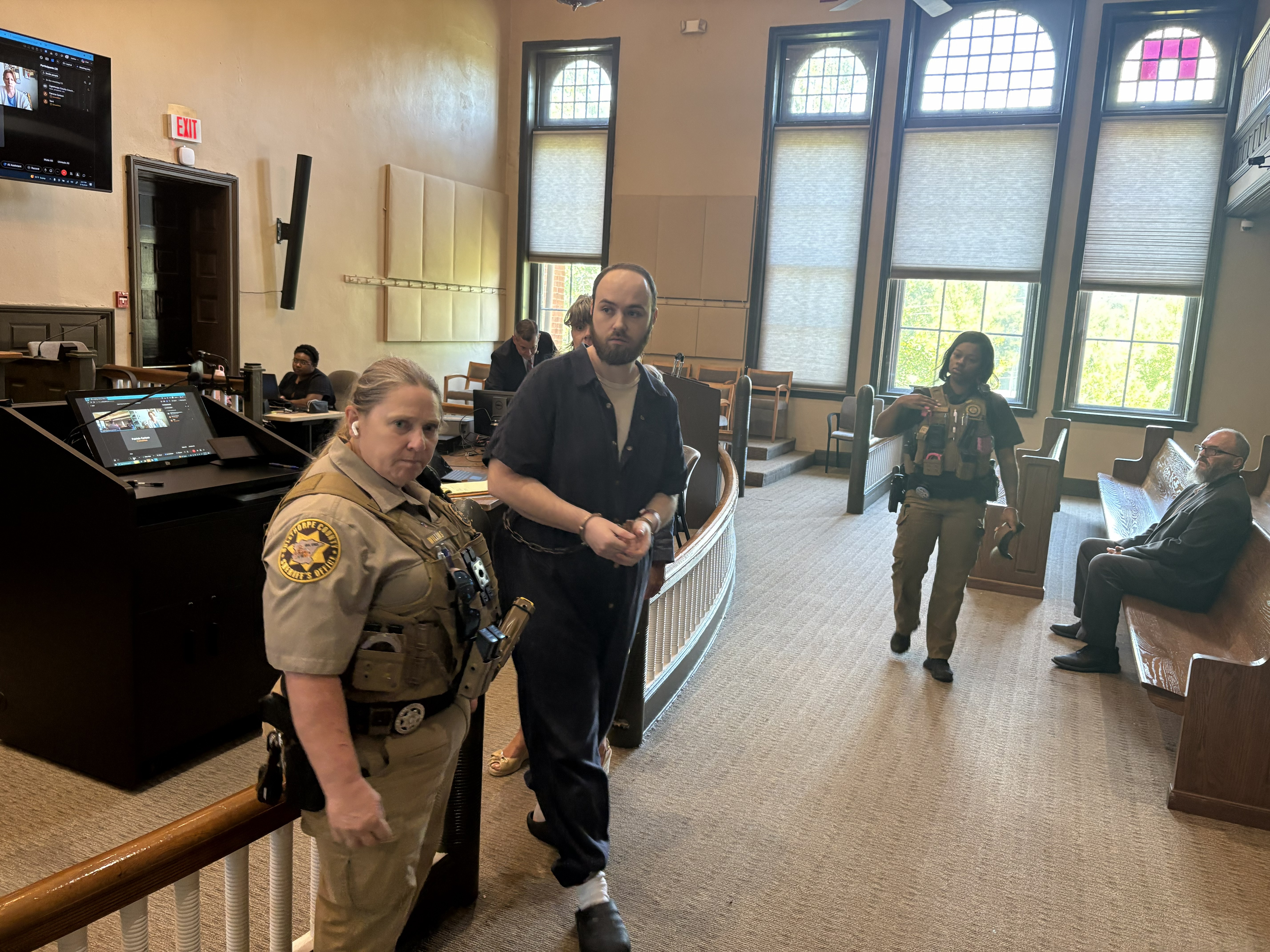
Kim Williams, a deputy with the Oglethorpe County Sheriff’s Office, escorts Michael Thomas Dusch from the courthouse after he was sentenced to life for the murder of David John Stewart. He pleaded guilty to all nine counts. (Dink NeSmith/The Oglethorpe Echo)
Michael Thomas Dusch is a serial killer. He murdered 69-year-old David John Stewart in Oglethorpe County, Georgia, and later murdered 84-year-old William Harris in Arkansas with a crossbow. He confessed to both killings. On August 18, 2026, Dusch pleaded guilty in Oglethorpe County Superior Court to every count in the Stewart indictment, including malice murder, and was sentenced to life in prison. He will not be eligible for parole consideration until 2055.
There is another fact about the case that deserves considerably more attention than it has received: automated license plate reader technology helped catch him. That matters because, in the same week Dusch was being brought to justice in Georgia, Flock Safety was retreating on one of the capabilities that made its system so valuable in the first place.
Under mounting public and political pressure over privacy and surveillance concerns, Flock announced on August 13, 2026, that it was changing its recommended default retention period from 30 days to just seven. The company says more than 90 percent of searches conducted without a complete plate occur within the first week. It has also introduced an Evidence Mode that allows investigators to preserve specific plate reads once they are known to be relevant to an active case. Existing customers may retain longer periods already approved by their communities, but new customers will be steered toward seven days.
At first glance, a week sounds prudent. It feels temporary, restrained, and privacy-conscious. The problem is the assumption buried inside that number: that investigators will know within seven days which information matters.
David Stewart’s murder demonstrates why they often do not.
Court records list February 7, 2025, as the offense date for Stewart’s murder and related crimes. Stewart lived alone. Dusch, a stranger, gained entry to his home, restrained him, obtained financial information, bludgeoned him to death, and dragged his body into the woods behind the house.
Stewart was not found until February 25, eighteen days later.
Under Flock’s new recommended default, ordinary historical plate data from the day Stewart was murdered could have disappeared on February 14, eleven days before anyone found his body. At the moment the retention clock expired, there was no homicide investigation, no suspect vehicle to flag, and no detective who could possibly have known that a particular plate observation might later become evidence.
Evidence Mode cannot solve that problem. You cannot preserve evidence of a crime you do not yet know occurred.
When investigators finally discovered Stewart, they had to reconstruct an old crime. After the murder, Dusch drove Stewart’s truck, and Flock cameras had recorded its movements. Investigators followed that trail to a Whataburger in Athens, obtained surveillance video showing Dusch using Stewart’s credit card, and developed an image of the man they were trying to identify.
The cameras did not solve the murder. Detectives did. But the cameras gave those detectives something they could not recreate after the fact: an objective historical record of where a vehicle had been before anyone understood why its movements mattered.
That distinction is too often lost in the rhetoric surrounding automated license plate readers. The word “surveillance” is used to describe several very different activities as though they were morally interchangeable. There is a meaningful difference between government selecting an innocent citizen for continuous observation without cause and a homicide detective searching historical vehicle observations to determine where a murder victim’s truck traveled. Both uses of technology deserve rules and oversight. They are not the same thing.
The Dusch case also demonstrates an equally important technical distinction between historical retention and real-time alerting. Georgia investigators needed the Flock system to remember where Stewart’s truck had been. The event that ultimately put Dusch in handcuffs in Texas required no such historical search.
While investigators were reconstructing Stewart’s murder, Dusch kept moving, and he killed again.
Hundreds of miles away in Logan County, Arkansas, 84-year-old William Harris lived alone. On March 2, a family member checking on him found him dead. Authorities determined that Harris had been killed with a crossbow and had been dead for about a week. Firearms and financial documents were missing from his home. Someone had also attempted to cash a check against Harris’s account using a stolen U.S. passport belonging to David Stewart, then abandoned the effort when bank employees became suspicious.
Two murders separated by hundreds of miles were suddenly part of the same story.
By then, Dusch was also wanted in North Carolina on multiple felony warrants involving sexual exploitation of a minor and was traveling in a stolen recreational vehicle. On March 6, 2025, that RV was sitting in a parking lot in Denton, Texas, when a license plate reader mounted on a patrol car scanned the plate and recognized the vehicle as stolen.
That was a hot-list hit, a real-time comparison of a passing plate against information already known to law enforcement. It did not depend on weeks of historical retention. The Georgia investigation did. Conflating those two capabilities turns a legitimate debate about retention into a much broader campaign against the technology itself.
Police stopped the RV and found Dusch. Inside were documents linking him to Stewart and Harris, along with a crossbow. A stolen-vehicle encounter in Texas had become part of a multistate investigation involving two murdered elderly men, crimes in Georgia and Arkansas, outstanding warrants in North Carolina, and evidence traveling across the country with the suspect.
Dusch eventually confessed to both murders. Georgia District Attorney Parks White later told the local newspaper that Dusch said he would talk about the crimes if he was given a banana and a Coke, then proceeded to confess. The detail is almost grotesquely ordinary. Two elderly men were dead, their killer was in custody, and technology had helped investigators reconstruct the trail that connected them.
That is the reality against which the DeFlock movement should be judged.
This does not mean every criticism of Flock is misguided. Some are plainly justified. Sworn officers are not the only people who have abused these databases. Civilian employees with access (real-time crime center analysts, dispatchers, community service specialists, and other staff) have done the same. Improper searches involving romantic partners, acquaintances, political targets, or people unrelated to legitimate investigations are indefensible no matter who conducts them. Overbroad interagency sharing deserves scrutiny. Any system capable of producing valuable investigative intelligence can also cause serious harm when entrusted to someone willing to abuse it.
Georgia has already seen exactly that kind of misconduct, and it has not been limited to people who carry a badge. This month, three former Bibb County sheriff’s deputies were arrested after an audit found that they had used Flock data to track people they knew personally. They were charged, among other things, with stalking and violating their oaths of office. They resigned.
It is not only deputies. In July, a supervisor in the Conyers Police Department’s Real-Time Crime Center was arrested after an audit found that she had used Flock more than thirty times to track her domestic partner’s vehicle. In Savannah, an internal audit led to the firing of six employees and the arrest of three officers and a civilian community service specialist on charges of misusing the license plate reader system. A desk in a crime center is not a sanctuary. Access is the issue, not the uniform.
Good. That is what accountability should look like.
If anyone with access to Flock uses it to stalk an ex-wife, spy on an acquaintance, or conduct some other unlawful personal search, the response should not be a memorandum reminding staff of the acceptable-use policy. Investigate the conduct. Fire the offender. If a crime was committed, prosecute it. If the offense and the law warrant incarceration, seek jail time.
Throw the book at the offender.
A public-safety system is entrusted to public servants for a public purpose. Use it to investigate crimes, locate victims, recover stolen property, and protect the public. Abuse it for personal, corrupt, or unlawful purposes and the consequences should be severe, whether the user is a deputy on patrol or an analyst behind a screen.
That is accountability. Deleting everyone else’s evidence is not.
This is where the more doctrinaire elements of the DeFlock movement lose the plot. They take the possibility of abuse and convert it into an indictment of the technology itself. An improper search becomes an argument for removing cameras. A poorly governed sharing arrangement becomes an argument for dismantling networks. A dishonest user becomes an argument for depriving honest investigators of historical evidence.
We do not ordinarily govern that way. We do not abolish criminal-history databases because an officer might improperly look up a neighbor. We do not stop collecting fingerprints because someone might misuse a fingerprint database. We do not destroy body-camera footage because an employee could watch it without authorization. We establish rules for access, audit their use, investigate misconduct, and punish offenders.
Flock should be treated the same way.
Agencies should require legitimate investigative purposes for searches. Queries should be tied to case numbers or call numbers. Access should be authenticated and auditable for every account, sworn or civilian. Logs should be immutable. Unusual search patterns should trigger review. Interagency sharing should operate under clear written policies.
Flock itself has begun moving in that direction. The company announced in August that case codes will be required for law-enforcement searches, that agencies must adopt tools designed to identify abnormal query patterns, and that customers will have greater control over which jurisdictions may search their data.
Those are sensible reforms because they target the actual vulnerability: the person using the system.
They constrain the user without destroying the evidence.
Privacy advocates are right about an important principle. Government power should be bounded. Law-enforcement technology should not operate beyond meaningful oversight, and public officials should never be permitted to substitute their claimed good intentions for enforceable rules. A conservative view of government should be particularly skeptical of concentrated power that cannot be audited or challenged.
But suspicion of government power does not require deliberate government amnesia.
There is a profound difference between limiting who may search a database and deliberately making the database incapable of answering a legitimate investigative question. The former restrains government power. The latter can cripple government competence.
The DeFlock movement too often blurs that distinction. License plate cameras become “surveillance infrastructure.” Observations of plates openly visible on public roads become “tracking.” Historical retention becomes “mass surveillance.” Once the vocabulary supplies the conclusion, deletion begins to look virtuous simply because it is deletion.
Criminal investigations are more complicated than that.
People live alone. Bodies go undiscovered. Missing people are not always reported immediately. Witnesses come forward late. A suspect emerges only after investigators obtain bank records, search warrants, telephone evidence, or surveillance video. A vehicle that meant nothing when it passed a camera can become central to a murder investigation weeks later.
The serious policy question cannot simply be how quickly government can erase the data. It must also ask how long that information retains legitimate investigative value, and how we preserve that value while controlling access and punishing abuse.
That is the part of the debate the Dusch case makes difficult to ignore.
The activists mapping Flock cameras, lobbying elected officials to cancel contracts, and pressing agencies toward shorter retention periods are entitled to scrutinize police technology. In some respects, their scrutiny has been useful. Misuse should be exposed. Poor policies should be rewritten. Excessive sharing should be curtailed. Public agencies should be required to explain what they collect and who may search it.
But advocates of aggressive deletion should also be required to acknowledge its cost.
Sometimes the benefit of deletion accrues to an ordinary citizen whose vehicle observation disappears from a government database. That privacy interest is real.
Sometimes it accrues to a burglar whose vehicle is not identified until investigators develop a lead ten days later, or a kidnapper whose plate becomes known only after a witness comes forward.
And sometimes it accrues to a serial killer whose first victim lies undiscovered long after the deletion clock has run out.
Acknowledging that does not end the privacy debate. It makes the debate honest.
David Stewart was murdered on February 7. His body was found on February 25. Under a seven-day retention regime, the historical record from the day of his murder could have disappeared before investigators even knew there was a homicide to solve.
That is enough to make the point.
The answer is not unlimited retention, unrestricted searching, or blind faith in law enforcement. Keep the cameras accountable. Require legitimate investigative purposes. Preserve audit logs. Control access and data sharing. Detect misuse aggressively. Fire abusers, sworn and civilian alike. Prosecute criminal misconduct. Seek jail time when the offense warrants it.
Do not destroy a tool because some people will abuse it. Punish the people who corrupt the tool instead of destroying the tool that helps catch people like Michael Thomas Dusch.
Dusch murdered two elderly men and confessed to both killings. Historical Flock data helped investigators reconstruct his trail in Georgia. A license plate reader helped police stop him in Texas.
The lesson is not that government should remember everything forever.
It is that evidence should survive long enough for us to discover the crime.