In this article
- The Son of Privilege
- The Base
- The American Soldiers in Arabia
- The Head of the Snake
- The Declaration
- The Embassies
- An Organization Learning to Think in Spectaculars
- The Airplane Idea
- The Cole and the Confidence of Survival
- The Summer When the System Began to Blink
- September
- Why America?
- His Great Miscalculation
- The House in Abbottabad
- The Black Bars
- References
How Osama bin Laden turned grievance, theology, humiliation, and strategic patience into a war against the United States, and what the CIA’s newly released intelligence briefs reveal about the long road to September 11
On September 11, 2026, twenty-five years to the day after four hijacked airliners transformed the American morning, the CIA opened another window onto the years before the catastrophe. Director John Ratcliffe declassified 71 President’s Daily Brief products and related intelligence reports, more than 100 pages of material prepared for the highest levels of the United States government between 1998 and the day after the attacks. The Agency describes it as the largest single release of CIA analysis related to 9/11.
Reading the collection in sequence is a peculiar and unsettling experience. The pages are scarred with black redactions and stamped with classifications that once restricted them to a handful of people. Their titles acquire, in retrospect, the cadence of an approaching storm: Terrorists Seeking WMD Capability. Potential Targets for Anti-US Attacks by Bin Ladin. Reports That Bin Ladin Is Planning Attacks Inside the US. Bin Ladin Preparing To Hijack US Aircraft and Other Attacks. Then, on August 6, 2001, the title that would become one of the most infamous phrases in the history of American intelligence: Bin Ladin Determined To Strike in US. The brief noted suspicious activity consistent with preparations for hijackings and roughly 70 FBI investigations related to bin Laden, yet still lacked the names, date, targets, and operational detail that might have converted strategic warning into prevention.
The documents do not reveal that the CIA secretly possessed the plan for September 11 and failed to act on it. They reveal something more complicated, and in some ways more disturbing. The United States understood with increasing clarity who Osama bin Laden was, what he believed, what he wanted, and the kind of spectacular violence he hoped to bring to America. What it did not understand until too late was precisely how the fragments fit together.
That distinction is the heart of the bin Laden story. He did not emerge from nowhere on a September morning in 2001. He spent more than a decade becoming the man who ordered that morning, and for much of that time he explained, publicly and repeatedly, why he had chosen the United States as his enemy.
The Son of Privilege
Osama bin Mohammed bin Awad bin Laden was born in Saudi Arabia in 1957, the seventeenth of more than 50 children of a construction magnate whose family business had become intertwined with the transformation of the modern Saudi state. He grew up not on the margins of society but near its privileged center. He was tall, quiet, physically athletic, personally austere, and possessed of a name associated with wealth, royal construction contracts, and the modernization of the kingdom.
At King Abdulaziz University, bin Laden encountered currents of Islamist thought that gave political meaning to his religiosity. Among the influences around him were the ideas of Sayyid Qutb, the Egyptian theorist whose writings portrayed modern secular society as a state of spiritual ignorance, and Abdullah Azzam, the Palestinian cleric who would become one of the great evangelists of the Afghan jihad. Bin Laden was not a formidable Islamic scholar. What distinguished him was something more useful to an emerging movement: money, organizational ability, connections, discipline, and an instinct for turning a cause into an infrastructure.
The Soviet invasion of Afghanistan in 1979 gave him his historical stage. Like thousands of Muslims drawn to the struggle, bin Laden came to see Afghanistan as proof that armed religious commitment could alter history. He helped finance fighters, build roads and facilities, arrange guesthouses, move recruits, and support the network that became known as Maktab al-Khidamat, the Services Office, alongside Azzam. He participated in combat, but the later image of bin Laden as a great battlefield commander was exaggerated. His real gift was logistical. He understood that the Afghan war was not merely a collection of battles; it was an international system of recruiting, money, travel, ideology, training, and personal relationships.
One persistent myth deserves burial here. The United States did arm and finance Afghan mujahideen fighting the Soviet occupation, largely through Pakistan’s intelligence service, but the 9/11 Commission found that bin Laden and the Arab volunteers around him had their own sources of support and received little or no American assistance. He was not a CIA creation who later turned against his maker. The relationship was far more indirect, and therefore less satisfying to conspiracy than to history.
By the end of the 1980s, the Soviet army was withdrawing. To bin Laden and many of the men around him, the obvious lesson was not that Moscow had been exhausted by a complicated combination of Afghan resistance, foreign assistance, economic decay, and political change. The lesson was simpler and more intoxicating: believers had defeated a superpower.
That conviction would eventually become fatal to thousands of Americans.
The Base
As the Afghan war wound down, bin Laden and his associates faced a question familiar to successful revolutionary movements: what becomes of the machinery after the war that created it has ended? Their answer was to preserve it.
Around 1988, the organization that became al-Qaeda, “the Base,” emerged from this milieu. It was intended to retain experienced fighters, relationships, training infrastructure, and the idea of a transnational jihad that would not end when the last Soviet soldier crossed the Afghan border. Azzam was assassinated in 1989, and bin Laden’s relationship with Egyptian militants, especially the physician Ayman al-Zawahiri, grew increasingly important. The Egyptian jihadists brought with them a darker intellectual tradition, forged through repression, prison, assassination campaigns, and a theological argument that rulers who failed to govern according to their conception of Islam could themselves become legitimate targets.
Bin Laden contributed something different. He gradually redirected the movement’s gaze away from the “near enemy,” the governments of Egypt, Saudi Arabia, and other Muslim states, and toward the “far enemy” that he believed kept those governments alive. If Washington was the power behind the regional order, then Washington, in his reasoning, was the head of the snake.
The transformation was not instantaneous. It took the Persian Gulf crisis to turn an increasingly radical Saudi Islamist into a man who would devote the rest of his life to war with the United States.
The American Soldiers in Arabia
When Saddam Hussein invaded Kuwait in August 1990, bin Laden returned from the Afghan jihad with the confidence of a man who believed he had participated in the defeat of an empire. He proposed that his veterans could help defend Saudi Arabia. The Saudi monarchy chose instead to invite the United States and its coalition partners onto the Arabian Peninsula.
For the Saudi government, the decision was an obvious matter of survival. Saddam possessed one of the largest armies in the region and had just swallowed a neighboring country. For bin Laden, the arrival of American troops was almost cosmically offensive. Saudi Arabia contained Mecca and Medina, Islam’s two holiest cities. The presence of non-Muslim military forces in the kingdom could therefore be presented not merely as geopolitics but as desecration, and the monarchy’s decision to depend upon those forces could be presented as proof that the House of Saud was both corrupt and illegitimate.
Here the personal, political, and theological began to fuse. Bin Laden had offered himself as a defender of the kingdom and been rejected. The royal family he had grown up adjacent to treated his proposal as fantasy. American military power accomplished what his veterans could not plausibly have done. The episode injured his conception of Saudi legitimacy and, just as importantly, his conception of himself.
His grievances multiplied. He condemned U.S. support for Israel and the plight of Palestinians. He attacked the sanctions imposed on Saddam Hussein’s Iraq, presenting Iraqi civilian suffering as evidence of a broader American war against Muslims. He denounced American support for governments such as Egypt and Saudi Arabia, which he considered corrupt and insufficiently Islamic. American troops in Somalia offered another battlefield on which these ideas could be tested. Later al-Qaeda reporting showed that members of bin Laden’s network assisted Somali militants, including with trainers skilled in weapons such as rocket-propelled grenades. When U.S. forces ultimately withdrew from Somalia after the brutal fighting of 1993, bin Laden absorbed the episode into his growing theory of history: Americans could inflict extraordinary violence, but they could not tolerate casualties indefinitely.
This interpretation would become one of his most consequential misreadings of the United States. Beirut in 1983, Somalia in the 1990s, and the Soviet withdrawal from Afghanistan became, in bin Laden’s mind, variations of the same story. Great powers looked invincible until someone proved willing to make them bleed.
The Head of the Snake
By 1991 he had relocated to Sudan, where Hassan al-Turabi’s Islamist government offered him an environment in which business, politics, and jihad could coexist. Bin Laden invested in construction, agriculture, transportation, and other enterprises while al-Qaeda operatives used commercial structures to move money, weapons, explosives, and people. Saudi authorities eventually stripped bin Laden of his passport, froze assets associated with him, and revoked his citizenship.
Popular legend later inflated his personal fortune to something approaching limitless wealth. The 9/11 Commission’s terrorist-financing investigation concluded that the famous claim of a $300 million inheritance was wrong. Bin Laden had access to significant money, but al-Qaeda increasingly depended upon fundraisers, wealthy donors, charities, facilitators, informal financial networks, and the relationships he had built during the Afghan war. His true fortune was less a vault than a network.
During the Sudan years, his hostility toward America hardened into strategy. Al-Qaeda began arguing that the United States should be attacked because it supported Israel, protected governments such as Saudi Arabia and Egypt, stationed military forces in Muslim lands, intervened in Somalia, and imprisoned militants associated with the movement. The local governments were enemies, but America was the power behind them. Remove the far enemy, the theory went, and the near enemies would become vulnerable.
This was the intellectual move that made bin Laden globally consequential. Countless radicals hated local governments. Countless militants opposed American policy. Bin Laden built an organization around the proposition that spectacular attacks against the United States could rearrange the political order of the Muslim world.
By 1996, Sudan had become inhospitable under growing international pressure, and bin Laden returned to Afghanistan. There, the Taliban was consolidating power under Mullah Mohammed Omar, and a relationship developed that neither pressure nor sanctions would ultimately break. The Taliban regarded bin Laden as a guest, valued the Arab fighters and money associated with him, remembered ties from the anti-Soviet war, and shared enemies with his movement. CIA reporting repeatedly found that Taliban leaders might restrain his public profile or complain about the trouble he created, but they would not surrender him. A March 2001 assessment concluded that the Taliban depended in part on his money and fighters and believed surrendering him would violate religious and tribal obligations.
Afghanistan gave bin Laden what Sudan increasingly could not: sanctuary beyond the easy reach of American law.
The Declaration
In August 1996, bin Laden publicly declared war against Americans in Saudi Arabia. The document was sprawling, historical, religious, aggrieved, and political all at once. It condemned the presence of American forces in the land of Islam’s holiest sites and framed their removal as an obligation.
Even then, however, a distinction remained between that declaration and what came next. The 1996 statement was principally directed at American military power in the Arabian Peninsula. Two years later, that boundary disappeared.
On February 23, 1998, bin Laden, Zawahiri, and several allied militants announced a new “World Islamic Front” and issued what they described as a fatwa. Neither bin Laden nor Zawahiri possessed the traditional religious credentials ordinarily associated with issuing such a ruling, a fact the 9/11 Commission emphasized. That did not matter operationally. The declaration asserted that Americans could be killed whether military or civilian and wherever they could be reached.
This was the moment when bin Laden’s war lost even its rhetorical limitation to soldiers and military installations. He had created a theological permission structure for mass murder.
The CIA itself returned to this document in a July 25, 2001 assessment, less than seven weeks before 9/11. Analysts described the 1998 fatwa as the ideological rationale behind the East Africa embassy attacks and noted that bin Laden’s network had subsequently continued to approve operations against Western military targets and civilians alike.
Six months after the declaration, the world saw what that meant.
The Embassies
On August 7, 1998, truck bombs exploded almost simultaneously at the American embassies in Nairobi, Kenya, and Dar es Salaam, Tanzania. Two hundred twenty-four people were killed. Thousands were injured. Most of the dead were not Americans, an early illustration of the moral arithmetic that would characterize al-Qaeda: Muslim and African civilians could become expendable so long as their deaths magnified the attack on the United States.
The United States responded with cruise-missile strikes against al-Qaeda facilities in Afghanistan and the Al-Shifa pharmaceutical plant in Sudan, whose alleged connection to chemical weapons remains disputed. Bin Laden survived. His survival mattered beyond the immediate military result because he could incorporate it into his mythology: America had hurled technologically sophisticated weapons across continents, and the man it wanted was still alive.
The newly released CIA documents become especially engrossing at this point because the tone changes. Bin Laden is no longer treated primarily as an extremist financier or propagandist. He is an operational enemy whose network is attempting to strike repeatedly, geographically, and sometimes imaginatively.
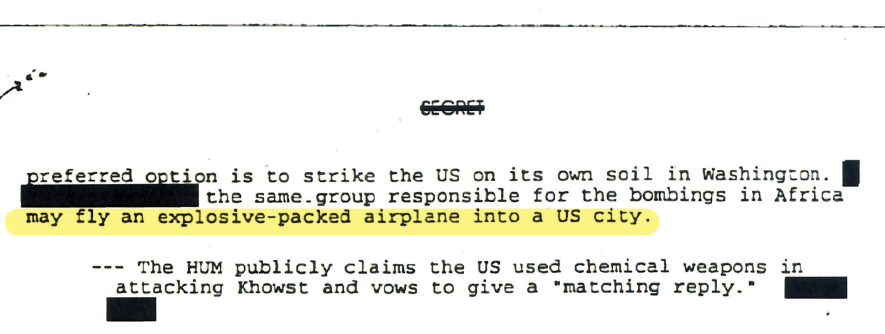
A June 1998 brief, written even before the embassy bombings, described potential military, civilian, oil, and government targets and reported discussion of “bringing the war home to America.” A July brief collected reports that bin Laden might be planning an attack inside the United States, although analysts explicitly described important sources as highly questionable. By September, a CIA memorandum reported that his preferred option was to strike the United States on its own soil in Washington and contained reporting that the group responsible for the African bombings might fly an explosive-packed aircraft into an American city.
None of this amounted to the 9/11 plan. That point matters enormously. Hijackings had been a familiar terrorist method for decades, sources were inconsistent, some reporting was false or deceptive, and the intelligence community was seeing a sprawling global picture filled with plots that were real, imagined, postponed, disrupted, abandoned, or misunderstood.
Yet viewed from the far side of history, the pattern is impossible to miss.
An Organization Learning to Think in Spectaculars
Bin Laden’s movement was becoming less like a conventional terrorist cell and more like a federation of capabilities. It had training camps, facilitators, charities, businessmen, forged documents, safe houses, couriers, recruiters, bomb makers, ideologues, and veterans scattered across continents. The CIA’s September 1998 reporting on his North American infrastructure described loosely connected people and organizations in the United States and Canada rather than a single disciplined underground army. That distinction was frustrating at the time and crucial in retrospect: the support structure was visible in pieces, while the operational structure remained obscure.
Bin Laden was also fascinated by weapons that might amplify terror beyond conventional explosives. The new collection begins, strikingly, with a February 1998 report titled Terrorists Seeking WMD Capability. Subsequent assessments described attempts to acquire chemical, biological, radiological, and nuclear materials; experiments with toxins and poisons; efforts to obtain uranium; and interest in crude radiological devices. Analysts were considerably more skeptical about what al-Qaeda could actually accomplish than its ambitions suggested. The organization might manage crude chemical or biological attacks or a radiological device capable of spreading fear and contamination, but a genuine nuclear capability remained far beyond what the intelligence indicated.
By February 2001, CIA analysts were still warning that bin Laden was pursuing unconventional weapons while distinguishing aspiration from capability. One assessment judged that his operatives could use crude poisons or biological toxins and might experiment with radiological dispersal, while the most frightening nuclear scenarios remained the least plausible.
The distinction between raw reporting and established fact is also worth keeping in mind. Some PDBs entertained reports that bin Laden or associates were involved in narcotics activity. The later 9/11 Commission financial investigation concluded there was no reliable evidence that drug trafficking was a significant source of al-Qaeda financing. Intelligence is not history written early. It is a moving argument conducted under pressure with incomplete evidence.
The Airplane Idea
The idea of using commercial aviation for mass-casualty terrorism did not originate on September 11. Ramzi Yousef and Khalid Sheikh Mohammed had already plotted to destroy American airliners over the Pacific in the 1994–95 Bojinka conspiracy. Yousef had also bombed the World Trade Center in 1993, hoping to topple one tower into the other. He failed at both ambitions, but the imagination behind them survived.
Khalid Sheikh Mohammed, known as KSM, eventually presented bin Laden with an even more dramatic proposal: train pilots to crash airplanes into buildings in the United States. According to the 9/11 Commission, KSM briefed bin Laden on the first World Trade Center attack, the Manila airline plot, and other ideas during a meeting in Afghanistan. The aircraft operation eventually became the September 11 conspiracy.
That proposal found a receptive audience because it fit bin Laden’s strategic personality. He preferred attacks that could function simultaneously as murder, political theater, religious propaganda, and demonstration of American vulnerability. Blowing up an embassy killed people. Destroying an American landmark before a global television audience could alter psychology.
By 2000 and 2001, bin Laden was personally involved in choosing men for the operation. The 9/11 Commission found that he and Mohammed Atef selected the future “muscle” hijackers, while KSM managed much of the detailed preparation. Recruits received instructions, money, travel guidance, and training while being compartmentalized from information they did not need to know.
Al-Qaeda had learned an essential lesson of clandestine work: an operation need not be centrally micromanaged to be centrally intended.
The Cole and the Confidence of Survival
On October 12, 2000, suicide attackers maneuvered an explosives-laden boat alongside the USS Cole in Aden harbor and detonated it, killing 17 American sailors and wounding dozens more. At first, intelligence considered several possible perpetrators. By January 2001, the CIA’s reporting increasingly pointed toward al-Qaeda planners, including Abd al-Rahim al-Nashiri, and one source said that “Shaykh Usama” had planned the attack years earlier.
The significance of the Cole was not merely operational. Bin Laden had survived American cruise missiles, international sanctions, arrests of associates, financial pressure, and repeated disruptions. His camps remained usable. His relationship with the Taliban endured. The United States could punish his organization and remove individual pieces, but he had not yet encountered a response capable of destroying the sanctuary from which the organization regenerated.
The CIA understood the problem. By the late 1990s it had established a dedicated bin Laden unit, developed covert plans involving Afghan proxies, and considered multiple opportunities to capture or kill him. Some plans failed because bin Laden moved unexpectedly. Others were abandoned because security was too strong or because women and children might be killed. Policymakers confronted the maddening asymmetry of counterterrorism before 9/11: the terrorist needed one opportunity; the state needed enough certainty to justify the consequences of acting.
Meanwhile, the target kept moving.
The Summer When the System Began to Blink
By the summer of 2001, warning indicators were everywhere, but specificity was nowhere.
The CIA was tracking a blizzard of reporting about attacks against American interests in Saudi Arabia, Bahrain, Yemen, Israel, Jordan, Europe, and elsewhere. A July 24 brief was ominously titled One Bin Ladin Operation Delayed, Others Continue. Reporting suggested that one operation had slipped but that preparations elsewhere remained active. The next day analysts revisited bin Laden’s 1998 fatwa, reminding senior policymakers of the ideological document that had authorized attacks on Americans.
Then came August 6.
Bin Ladin Determined To Strike in US was written in response to presidential interest in the possibility of an attack at home. It summarized bin Laden’s long-standing desire to strike inside the country, recalled earlier reporting about Washington, noted the millennium plot targeting Los Angeles International Airport, described al-Qaeda-associated people living or traveling in the United States, and reported FBI information concerning suspicious activity consistent with preparations for hijackings. It also said the Bureau was conducting approximately 70 full-field investigations throughout the United States considered bin Laden-related.
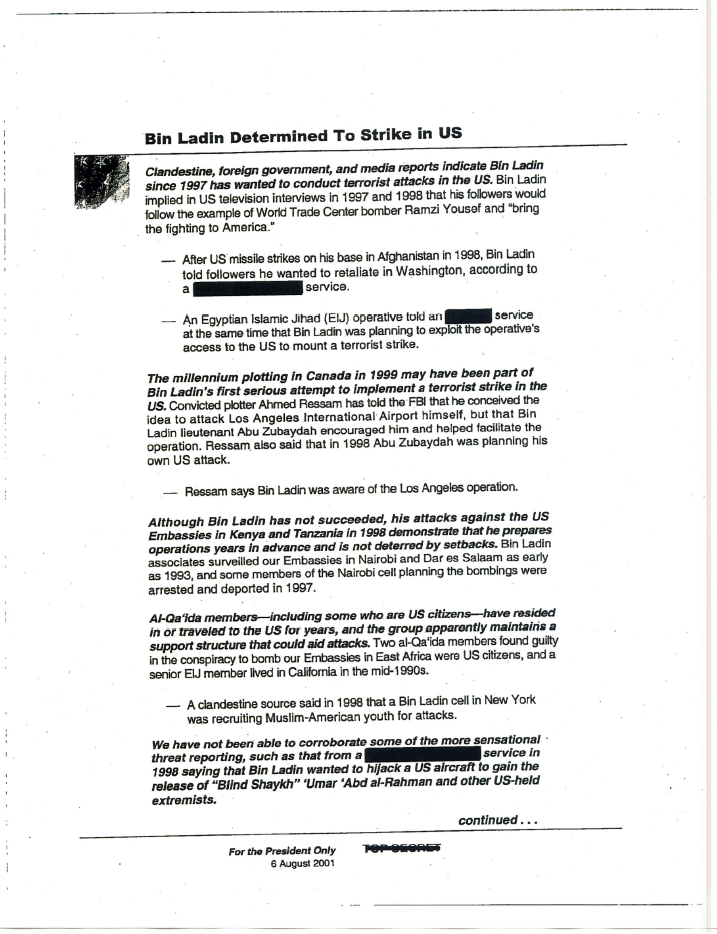
It was an extraordinary warning of intent and an inadequate warning of event.
There was no statement that 19 men had been chosen. No September 11 date. No four flights. No World Trade Center. No Pentagon. No flight schools tied together into an operational picture. Some earlier reporting about hijackings concerned hostage exchanges rather than suicide attacks. Other reporting had proved unreliable. The intelligence system knew the enemy wanted to strike the homeland but did not possess the architecture of the coming attack.
That does not mean the failure was inevitable. The 9/11 Commission later found serious institutional failures, especially in sharing and acting upon information concerning future hijackers Khalid al-Mihdhar and Nawaf al-Hazmi after they had entered the United States. It concluded more broadly that, despite the strategic warning, domestic agencies were not effectively mobilized in the summer of 2001.
Three weeks after the August 6 PDB, another CIA assessment described al-Qaeda operations as “expert and flexible.” The organization practiced surveillance, compartmented information, allowed some cells discretion over timing and targets, and could recover from disruption. Read now, it sounds almost like an explanation written in advance for why finding the final plot would prove so difficult.
September
Two days before the attacks, Ahmed Shah Massoud, the legendary Northern Alliance commander and the Taliban’s most formidable Afghan enemy, was assassinated by two al-Qaeda operatives posing as journalists. The killing removed a powerful Taliban opponent at precisely the moment bin Laden was about to bring catastrophe upon his hosts.
Then came Tuesday morning.
Nineteen hijackers took control of four passenger jets. Two struck the World Trade Center. One struck the Pentagon. Passengers aboard United Flight 93 fought back, and the aircraft crashed in Pennsylvania. Nearly 3,000 victims were killed.
By 4 a.m. the following morning, the CIA was already trying to reconstruct the road behind the disaster. The newly released September 12 Situation Report is among the most haunting documents in the collection. It records pre-attack indications that something was imminent, reports that knowledge of a probable operation had circulated among extremists in Afghanistan, and describes a confrontation between bin Laden and Mullah Omar over operations that could cause enormous damage to the United States. Reporting suggested the attacks had been two years in planning and mentioned the possibility that the White House had been among the intended targets.
The intelligence had changed tense. What had been warning was now archaeology.
Why America?
It is tempting to answer the question of bin Laden’s hatred with a list of grievances. American troops in Saudi Arabia. Israel and Palestine. Iraq. Somalia. Support for Arab governments he despised. American influence in the Muslim world.
All of those things mattered to him. None, by itself, explains him.
Bin Laden’s ideology transformed political disagreements into evidence of a civilizational war. American support for Saudi Arabia did not merely become a policy he opposed; it proved that America sustained apostate rulers. Support for Israel did not merely become a geopolitical grievance; it became part of a supposed Jewish-Crusader assault on Islam. Sanctions on Iraq became evidence of deliberate war on Muslim children. American culture itself could be presented as corruption exported into Islamic society.
Within such a worldview, contrary evidence becomes almost impossible. If America intervenes militarily, it is an imperial occupier. If it supports a Muslim government, it is the hidden power behind apostasy. If it withdraws after casualties, it is weak. If it retaliates, the retaliation proves that the war he predicted was real.
That intellectual machinery made bin Laden dangerous because it converted grievance into an unfalsifiable worldview and then converted the worldview into permission to kill strangers.
His strategic insight, however grotesque its purpose, went beyond hatred. Bin Laden believed the United States could be provoked into exhausting itself. He interpreted the Soviet experience in Afghanistan as proof that a superpower could be bled economically and psychologically until political will collapsed. After 9/11, he would describe a strategy of drawing America into expensive wars and forcing it to disperse military and intelligence resources across the Muslim world. Analysts later characterized this as a “bleed until bankruptcy” strategy.
In that sense, the spectacular attack was never meant to be the end of the war. It was meant to start the kind of American reaction from which bin Laden believed his movement could profit.
His Great Miscalculation
Bin Laden was right about one thing: September 11 would change America. He was catastrophically wrong about much of what would follow.
Within weeks, American forces entered Afghanistan. CIA officers, special-operations troops, American airpower, Afghan militias, and coalition partners helped overthrow the Taliban government that had sheltered him and destroyed much of al-Qaeda’s open training infrastructure. Mohammed Atef, one of his senior lieutenants and a key figure in the 9/11 operation, was killed. Hundreds of operatives were captured or scattered.
Bin Laden escaped, eventually crossing into Pakistan. The failure to capture him at Tora Bora would haunt the campaign, but the sanctuary from which September 11 had been organized was shattered.
Then history became more complicated. The invasion of Iraq in 2003 created a new battlefield that bin Laden had not created but eagerly exploited. The occupation supplied jihadist propaganda, attracted foreign fighters, intensified anti-American sentiment, and gave al-Qaeda and its ideological descendants a war in the heart of the Arab world. Bin Laden explicitly welcomed the prospect of drawing American power into prolonged, expensive conflicts.
Yet his larger political objectives remained unrealized. The United States did not collapse. The Saudi monarchy did not fall. The Muslim world did not unite behind al-Qaeda. Al-Qaeda central was progressively hunted, disrupted, and isolated. The movement inspired affiliates and imitators, but it also spawned brutal sectarian violence that repelled many of the Muslims in whose name it claimed to act.
His war had produced consequences on a scale even he may not have fully imagined, but it had not produced his promised victory.
The House in Abbottabad
For almost a decade, bin Laden disappeared from ordinary view. His survival depended increasingly upon the opposite of the globalized infrastructure he had once built. He avoided phones and electronic communications and relied upon trusted couriers.
That dependence ultimately betrayed him.
American intelligence spent years identifying one of those couriers, connecting a pseudonym to a real person, and tracing the network until it led to an unusual compound in Abbottabad, Pakistan. On May 2, 2011, local time, U.S. Navy SEALs raided the compound and killed bin Laden. The CIA has described the operation as the culmination of years of painstaking intelligence work centered on the courier network that protected him.
His death ended the life of the man who had built al-Qaeda but not the ideas he helped normalize. Al-Qaeda affiliates persisted. ISIS eventually emerged as both descendant and rival, embracing an even more theatrical brutality while disagreeing with al-Qaeda over strategy, timing, governance, and the sequencing of enemies.
Bin Laden had failed to establish the political order he imagined. He nevertheless succeeded in changing the strategic vocabulary of an era.
The Black Bars
That is what makes the CIA’s newly released pages worth reading now. They are not a revelation that somebody knew everything. They are a record of many people knowing many things, some true, some false, some fragmentary, some terrifyingly accurate, without ever knowing quite enough at the same time.
The documents show analysts watching bin Laden evolve from financier to organizer, from organizer to ideologue, from ideologue to operational commander. They watched him seek unconventional weapons, cultivate international infrastructure, benefit from Taliban sanctuary, discuss American targets, consider hijackings, survive disruption, and insist that the war eventually had to reach American soil. The August 6 PDB has become famous because of what happened five weeks later, but the new collection makes clear that it was not an isolated flash of insight. It was one tile in a mosaic assembled over years.
The lesson is neither that intelligence failed completely nor that the attacks were therefore unavoidable. Intelligence had identified the adversary’s intent with startling precision, while government institutions failed in important ways to connect people, travel, warnings, and jurisdictions. At the same time, much of what intelligence officers actually possessed consisted of precisely the material visible in these documents: fragments, rumors, penetrations of uncertain reliability, interrupted operations, outdated plans, real plots mixed with phantom ones, and an opponent deliberately designing his organization so that any captured piece revealed as little as possible.
There is something almost cruel about reading the pages in order because the reader possesses the one piece of intelligence denied to everyone who wrote them: the future.
We know which warning mattered. We know which airplane idea became real. We know which men were important. We know which morning the clock was counting toward.
They did not.
And that may be the most unsettling truth in the entire collection. Osama bin Laden did not hide his hatred of the United States. He advertised it, theologized it, organized around it, killed for it, and spent years trying to bring his war to American soil. The United States saw the enemy coming long before it saw the attack.
The distance between those two kinds of knowledge turned out to be 102 minutes on a Tuesday morning.
References
Central Intelligence Agency. (2026, September 11). 71 declassified 9/11-related President’s Daily Brief products [Declassified intelligence collection]. https://www.cia.gov/stories/story/cia-releases-presidents-daily-briefs-in-commemoration-of-the-25th-anniversary-of-9-11/seventy-one-declassified-presidents-daily-brief-products/
Central Intelligence Agency. (2026, September 11). CIA releases President’s Daily Briefs in commemoration of the 25th anniversary of 9/11. https://www.cia.gov/stories/story/cia-releases-presidents-daily-briefs-in-commemoration-of-the-25th-anniversary-of-9-11/
Central Intelligence Agency. (n.d.). The final chapter in the hunt for Bin Ladin. CIA Museum. https://www.cia.gov/legacy/museum/exhibit/the-final-chapter-in-the-hunt-for-bin-ladin/
National Commission on Terrorist Attacks Upon the United States. (2004). The 9/11 Commission report: Final report of the National Commission on Terrorist Attacks Upon the United States. U.S. Government Printing Office. https://www.9-11commission.gov/report/911Report.pdf
National Commission on Terrorist Attacks Upon the United States. (2004, June 16). Overview of the enemy (Staff Statement No. 15). https://www.9-11commission.gov/staff_statements/staff_statement_15.pdf
Roth, J., Greenburg, D., & Wille, S. (2004). Monograph on terrorist financing: Staff report to the Commission. National Commission on Terrorist Attacks Upon the United States. https://www.9-11commission.gov/staff_statements/911_TerrFin_Monograph.pdf
Riedel, B. (2007, May 1). Al Qaeda strikes back. Foreign Affairs. Reproduced by the Brookings Institution. https://www.brookings.edu/articles/al-qaeda-strikes-back/
Riedel, B., & Saab, B. Y. (2008, March 1). Al Qaeda’s third front: Saudi Arabia. Brookings Institution. https://www.brookings.edu/articles/al-qaedas-third-front-saudi-arabia/
U.S. Department of Justice. (2009, June 9). Fact sheet: Prosecuting and detaining terror suspects in the U.S. criminal justice system. Office of Public Affairs. https://www.justice.gov/archives/opa/pr/fact-sheet-prosecuting-and-detaining-terror-suspects-us-criminal-justice-system
U.S. Department of Justice. (2011, April 4). United States v. Khalid Sheikh Mohammed et al. [Indictment]. U.S. District Court for the Southern District of New York. https://www.justice.gov/archive/opa/documents/ksm-indictment.pdf
U.S. Department of Justice. (2014, September 19). International terrorism defendant pleads guilty in Manhattan federal court. Office of Public Affairs. https://www.justice.gov/archives/opa/pr/international-terrorism-defendant-pleads-guilty-manhattan-federal-court
U.S. Department of State. (1998, August 20). Press briefing on U.S. strikes in Sudan and Afghanistan. https://1997-2001.state.gov/www/statements/1998/980820.html