


The United States and Iran have entered their most consequential negotiations in nearly half a century. The talks, now underway in Islamabad, represent the highest-level engagement between Washington and Tehran since the 1979 Islamic Revolution. They follow six weeks of sustained conflict and rest uneasily atop a fragile, two-week ceasefire. The objective is simple to describe and difficult to achieve. It is to turn a temporary pause in hostilities into something that lasts.
Both delegations arrived in Pakistan’s capital within the past twenty-four hours. Iran is represented by Parliament Speaker Mohammad Bagher Ghalibaf and Foreign Minister Abbas Araghchi. The American delegation is led by Vice President JD Vance, accompanied by special envoy Steve Witkoff and Jared Kushner.
Pakistan has taken on the role of mediator, hosting negotiations inside the heavily secured Red Zone of Islamabad. Meetings alternate between direct bilateral sessions and trilateral engagements with Pakistani officials. Even the structure of the talks reflects the deep mistrust between the parties.
Earlier in the day, Vice President Vance met with Prime Minister Shehbaz Sharif. Iranian officials held parallel discussions with Pakistan’s military and diplomatic leadership. The choreography is deliberate. Each side signals a willingness to negotiate while carefully managing domestic and international perceptions.
The issues under discussion are expansive. They include freedom of navigation through the Strait of Hormuz, sanctions relief, regional ceasefires such as in Lebanon, Iran’s nuclear program, and broader de-escalation measures. Pakistan’s ambitions are more limited. Its immediate goal is to sustain dialogue long enough to extend the ceasefire beyond its April 22 expiration.
The atmosphere remains tense. President Trump has described Iran as militarily defeated and warned that the United States is prepared to act unilaterally to reopen the Strait of Hormuz if necessary. Iranian officials have responded with preconditions and accusations of ceasefire violations. Security across Islamabad reflects the stakes. The Red Zone is sealed. Roads are closed. Forces are deployed in strength.
These talks may last days. They may stretch longer. The outcome is uncertain. The implications are not.
The Stage
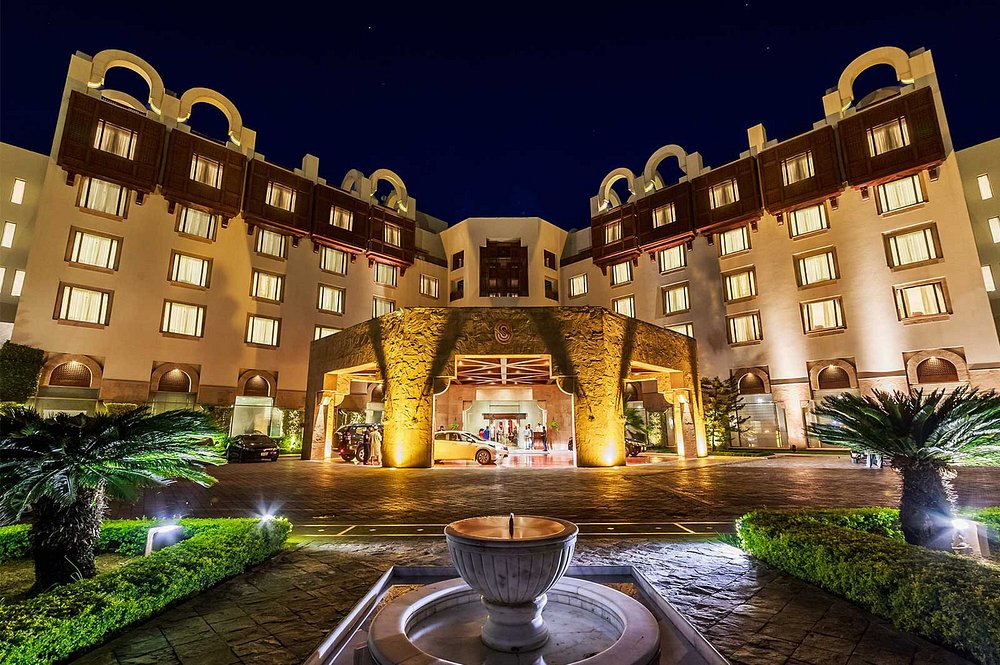
The negotiations are taking place inside the Islamabad Serena Hotel, a luxury property fully requisitioned by the Pakistani government.
Set against the Margalla Hills and embedded within the capital’s fortified administrative district, the hotel offers both seclusion and proximity to power. Its gardens, conference halls, and private suites have been transformed into a temporary diplomatic enclave.
Pakistan selected the venue for practical reasons. The Serena combines high-end accommodations with a proven record of hosting sensitive international meetings. Its infrastructure allows for simultaneous negotiations, private consultations, and tightly controlled movement of delegations.
In the days leading up to the talks, the government cleared the property of guests and imposed a broader lockdown across the city. Public holidays were declared. Checkpoints multiplied. Anti-drone systems were activated. Islamabad has been reshaped, if only briefly, around diplomacy.
The setting carries its own message. It signals neutrality, control, and intent. It also reinforces Pakistan’s role as a broker in negotiations that neither side fully trusts.
Who Speaks for Iran
Power in Iran rests, both in law and in practice, with the Supreme Leader. Today that role belongs to Mojtaba Khamenei, who succeeded his father after his death in the opening phase of the war.
Yet his authority is shadowed by uncertainty.
Khamenei has not appeared publicly since assuming office. Iranian officials insist he remains engaged, directing policy from Qom and participating in key decisions. Intelligence assessments from the United States and Israel suggest a different reality. They describe a leader severely injured, possibly incapacitated, and unable to govern directly.
The truth remains obscured behind deliberate opacity.
This ambiguity complicates the negotiations. The Iranian delegation brings experience and institutional weight. Ghalibaf and Araghchi are seasoned operators with deep ties to the regime. Yet their authority may be conditional rather than absolute.
If the Supreme Leader cannot exercise full control, decision-making may be dispersed among the Islamic Revolutionary Guard Corps and other hardline factions. That raises a central question. Any agreement reached in Islamabad must not only be signed. It must be enforced.
Uncertainty at the top makes that assurance difficult to secure.
The Ceasefire
The ceasefire is holding, but only just.
Its central condition is stark. The Strait of Hormuz must remain open. That single requirement has stabilized global energy markets and interdicted a shock that has rippled across every major economy.
Beyond that, little has been resolved.
The truce was never intended to last. It is a narrow window in which diplomacy might succeed. If negotiations fail, military operations will resume. Both sides understand this. Neither side doubts it.
For once, however, the balance of leverage is clear. The United States arrives with advantage.
That advantage was not negotiated. It was imposed.
The Campaign That Changed the Calculus
On February 28, 2026, American and Israeli forces launched Operation Epic Fury. In its opening twelve hours, hundreds of strikes targeted Iran’s air defenses, missile systems, command infrastructure, and leadership compounds.
The effects were immediate and severe.
Iran’s air defense network was degraded across key sectors. Its air force was reduced to a fraction of its former capability. Naval assets were damaged. Critical petrochemical and military-industrial facilities were struck, constraining both revenue and resilience.
The campaign extended into the leadership itself. Senior officials, commanders, and intelligence figures were eliminated over the course of the operation.
The regime’s coercive apparatus, long the foundation of its control, was weakened at a moment of internal strain. Economic hardship, public discontent, and the cumulative costs of conflict have eroded stability at home.
Iran’s most potent strategic lever, the ability to threaten the Strait of Hormuz, has been blunted. Regional actors have adjusted. Diplomatic space has narrowed. The Islamic Republic finds itself in an unfamiliar position. It is militarily degraded, economically constrained, and politically exposed.
This is not without precedent.
In 1988, Ayatollah Khomeini accepted a ceasefire with Iraq under conditions he likened to drinking poison. In 2015, Tehran entered the JCPOA under the pressure of sanctions and isolation. In each case, the regime adapted to survive.
Today’s ceasefire belongs to that lineage. It reflects necessity, not choice.
The Risk of Repetition
There is a familiar temptation in Washington.
Stabilize the situation. Reduce immediate risks. Declare success. Move on.
That instinct shaped the JCPOA. It imposed limits but left core capabilities intact. Iran retained enrichment infrastructure, expanded its missile program, and deepened its regional networks. The agreement bought time. It did not resolve the underlying problem.
Islamabad presents a rare opportunity to break that pattern. It also presents every opportunity to repeat it.
What Washington Should Demand
The United States enters these talks with leverage that is both real and temporary. It must use it accordingly.
The nuclear program is the most urgent issue. Temporary limits are insufficient. The objective must be verifiable dismantlement of weapons-relevant enrichment capabilities, neutralization of stockpiles, and permanent closure of facilities designed for strategic ambiguity. Verification must be continuous, intrusive, and independent.
Ballistic missiles cannot be treated as secondary. They are the delivery mechanism that transforms nuclear capability into strategic threat. Binding limits on development, testing, and deployment are essential.
The proxy network is equally central. For decades, Iran has projected power through allied militias and armed groups. Any durable agreement must include enforceable commitments to halt support, funding, and coordination with these actors.
Enforcement is the final pillar. Agreements fail when violations carry no immediate consequence. Sanctions relief must be conditional and reversible. Monitoring must not depend on consensus. Freedom of navigation through the Strait of Hormuz must be guaranteed through mechanisms that remove Iran’s ability to threaten global commerce.
These demands are ambitious. The moment requires ambition.
Realism and Its Limits
There is a counterargument, and it carries weight.
Press too hard and the regime may fracture. Instability could produce proliferation risks or regional chaos. A weakened Iran may become more unpredictable in the short term.
That risk is real. It is also familiar.
The alternative is quieter but no less dangerous. A regime that survives, adapts, and rebuilds will reconstitute its capabilities. Time has always been its ally. Leave the underlying structures intact and the cycle will repeat.
The stakes extend beyond Iran. A successful agreement would reduce volatility across the Middle East, stabilize energy markets, and reinforce the credibility of American power. Failure would signal that even decisive military action cannot produce lasting political outcomes.
That lesson will not remain confined to Tehran.
A Narrower Audience
There is another audience, often overlooked.
The Iranian people.
Iran is a nation of depth and capacity. Its population is educated, its geography strategic, and its potential substantial. A state that steps back from confrontation and re-engages economically could recover with surprising speed.
Diplomacy cannot impose that transformation. It can only create the conditions in which it becomes possible.
The choice remains Tehran’s.
The Test
The ceasefire has created a rare alignment. American leverage is tangible, but it is also temporary.
Such moments do not linger.
Washington now faces a clear decision. It can translate military advantage into structural constraints that reduce the likelihood of future conflict. Or it can settle for an agreement that manages risk without resolving it.
The latter would feel familiar. It would also be a mistake.
Iran has been brought to the table by force. The question is what it will carry away from it.
Constraint, or simply time.
History suggests the regime understands the difference.
So should America.
Iran’s Grand Opportunity
Beyond the immediate bargaining points and the quieter audience of the Iranian people lies something larger. This moment presents a generational off-ramp that has not existed in the history of the Islamic Republic. For the first time since 1979, Tehran has both the incentive and the leverage to abandon the architecture of its revolutionary foreign policy and reenter the international system as a responsible stakeholder rather than a persistent source of disruption.
This would require a deliberate strategic shift. Iran would need to accept the verifiable dismantlement of weapons-relevant nuclear infrastructure, an enforceable end to the funding and arming of Hezbollah, the Houthis, Hamas, and other militias, and binding guarantees on freedom of navigation through the Strait of Hormuz. In return, it would gain a path back into global commerce, finance, and diplomacy.
For future generations of Iranians, the implications would be profound.
Today’s young population is educated, ambitious, and globally connected, yet burdened by isolation. Brain drain has thinned the country’s talent base. Economic growth has been constrained. Daily life has unfolded under the persistent weight of sanctions and political restriction.
Reintegration could reverse that trajectory with surprising speed. Sanctions relief would unlock investment across energy, manufacturing, and technology. Tourism could revive historic sites from Persepolis to Isfahan. Iranian professionals could collaborate openly with international partners. Universities could reconnect with the global academic community. The diaspora could return or invest with confidence.
The social effects could be equally significant. Women could expand their participation in economic and civic life. Over time, the country could shift from one defined by sanctions and suspicion to one recognized for its contributions to science, culture, and trade. Within a generation, Iranian children could grow up in a nation associated with prosperity rather than isolation.
The benefits would extend beyond Iran. A stable Iran would deprive militant networks of resources and direction, giving countries such as Lebanon, Yemen, and Syria space to rebuild. Global energy markets would gain stability in the Strait of Hormuz. Nuclear proliferation risks would decline. Israel and the Gulf states could move from containment toward economic engagement.
None of this requires external regime change. It requires a decision from within.
Those who hold power in Tehran must recognize the moment for what it is. It is an opportunity to exchange revolutionary posture for national renewal.
Islamabad is not just a venue for negotiation.
It is where that choice begins.