

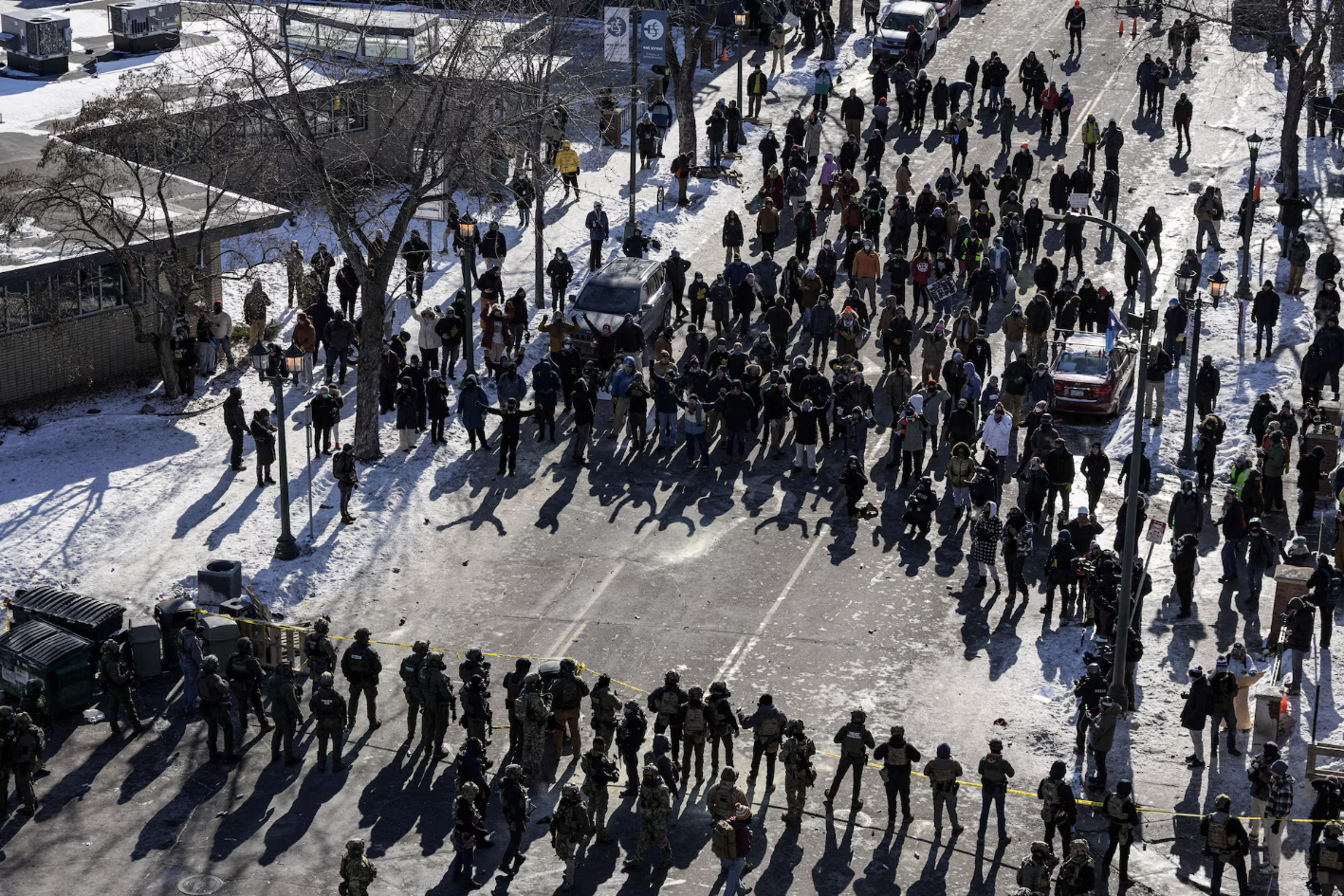
Federal agents line up in front of community members at the scene where federal agents fatally shot Alex Pretti, January 24. REUTERS/Tim Evans
Before any legal analysis, before doctrines and precedents, before arguments about authority or resistance, there is a simpler and more damning truth: two people are dead who did not need to be. Renee Nicole Good and Alex Pretti were not abstractions or case studies. Loved by family, friends, colleagues, and neighbors, their lives were cut short in encounters that should never have reached a lethal outcome. Their deaths are a shameful loss, not because accountability is unclear, but because prevention was entirely possible. In the greatest country in the world, one that prides itself on ordered liberty and the rule of law, these outcomes represent a failure of judgment and restraint on multiple levels. We are better than this, or at least we claim to be. A nation capable of resolving its deepest disputes through discourse or courts rather than violence should not accept that routine enforcement actions spiral into irreversible tragedy. The fact that these deaths occurred at all is not a testament to inevitability, but to a breakdown in the very safeguards meant to protect life.
Having said that, there is a hard truth that most Americans do not want to hear, and fewer still are prepared to accept. In the realm of law enforcement use of force, responsibility is often shared. That statement is not a moral abdication by the state, nor is it an endorsement of unchecked police power. It is simply reality. Encounters that end in death are almost never the result of a single choice, a single actor, or a single failure. They are the cumulative consequence of cascading decisions, misjudgments, stress responses, institutional culture, and human frailty on both sides of the badge.
I spent nearly two decades in law enforcement analyzing and studying use-of-force incidents. I have lived inside this uncomfortable space. I have watched legally justified use of force hollow out communities. I have seen officers cleared in investigations while privately acknowledging they would give anything to relive thirty seconds of their lives. I have also watched civilians make catastrophic decisions in moments where compliance, patience, or distance would almost certainly have preserved their lives. These truths coexist, even when it is politically inconvenient to say so.
The recent ICE-involved killings of Renee Nicole Good and Alex Pretti in Minneapolis sit squarely in this moral gray zone. They are not simple stories of state violence, nor are they morality plays where only the deceased erred. They are cautionary tales about escalation, misplaced courage, institutional rigidity, and the peril of street-level confrontation with armed federal agents operating under expansive legal authority.
How Force Is Actually Judged
To understand why no ICE agents are likely to be prosecuted, the public must first understand how force is evaluated in American courts. Use of force is not judged by outcomes. It is judged by perception. The legal framework rests on the Fourth Amendment and a line of Supreme Court decisions that deliberately reject hindsight.
The cornerstone is Graham v. Connor (1989), which established the “objective reasonableness” standard. The Court held that force must be evaluated from the perspective of a reasonable officer on the scene, not with the clarity of 20/20 hindsight. Judges and juries are instructed to consider that officers are forced to make split-second decisions in tense, uncertain, and rapidly evolving circumstances.
Tennessee v. Garner (1985) narrowed when deadly force may be used, holding that an officer may not shoot a fleeing suspect unless there is probable cause to believe the person poses a significant threat of death or serious bodily harm. Importantly, Garner does not require that the threat be correct. It requires that the belief in the threat be reasonable.
Subsequent cases have strengthened these protections. In Scott v. Harris (2007), the Court ruled that even lethal risks created by police during a pursuit can be reasonable if the suspect’s actions endanger the public. In Plumhoff v. Rickard (2014), officers were granted qualified immunity after firing fifteen shots into a fleeing vehicle, reinforcing that the number of rounds fired does not itself render force unreasonable. In Mullenix v. Luna (2015), the Court emphasized that clearly established law must be specific, not general, further insulating officers from criminal liability.
Federal agents enjoy even broader protection. ICE officers operate under federal authority, and any criminal prosecution would require the Department of Justice to prove beyond a reasonable doubt that an agent willfully violated constitutional rights. That is an extraordinarily high bar. Absent explicit evidence of malicious intent or conduct far outside accepted training, prosecutions almost never succeed.
This is why the public should not expect indictments. Not because the deaths do not matter, but because the legal system is designed to err on the side of officer discretion in violent encounters.
The Missteps That Matter
None of this absolves the agents involved. But it also does not erase the choices made by the deceased.
In both Minneapolis incidents, available accounts suggest that the individuals killed placed themselves in proximity to an active federal enforcement operation. That decision alone dramatically increased risk. Federal agents conducting arrests are primed for resistance, interference, and ambush. They are armed, keyed up, and operating under rules that presume volatility.
For Renee Nicole Good, reports indicate non-compliance and perceived advancement toward agents during a chaotic encounter. Even if her intentions were not violent, proximity, movement, and refusal to disengage can be interpreted as threat indicators under training models. Distance is safety. Compliance buys time. Time saves lives. These are not moral judgments. They are practical realities.
Alex Pretti’s case reflects a common civic impulse that turns deadly. Witnesses say he was recording agents and intervening verbally or physically on behalf of another person. Many Americans believe, wrongly, that moral righteousness confers tactical immunity. It does not. Recording police is lawful. Interjecting oneself into an arrest is not. Attempting to assist the target of a law enforcement action, however well-intentioned, is indistinguishable from obstruction or assault in the moment.
Citizens must understand this clearly. The street is not the venue for adjudicating law enforcement conduct. Courts are. Oversight bodies are. Civil litigation is. When civilians insert themselves physically into enforcement actions, they collapse the distinction between bystander and participant, and officers respond accordingly.
This does not mean the deaths were deserved. It means they were avoidable.
Where De-Escalation Failed
Acknowledging civilian missteps does not excuse institutional failure. Federal agents may be trained in de-escalation, but training is only as effective as culture allows it to be. ICE operates under a mission structure that emphasizes enforcement efficiency and control. That culture often clashes with the patience de-escalation requires. That reality needs to change, and it needs to change quickly to preserve life.
In both incidents, questions persist about whether agents created time and distance, whether clear commands were issued, and whether less-lethal options were realistically considered. De-escalation is not just talking calmly. It is repositioning, slowing the encounter, using barriers, and disengaging when the mission allows it.
Federal agents are not beat cops. They are not responsible for maintaining immediate street order. In many circumstances, disengagement is an option. That option appears to have been foreclosed too quickly.
De-escalation failures are rarely criminal. They are systemic. They reflect training that treats escalation as inevitability rather than risk. They reflect leadership that prioritizes operational dominance over public legitimacy. And they reflect a broader federal posture that has grown increasingly intolerant of civilian scrutiny.
Why Accountability Feels Absent
The refusal to allow state investigators immediate access to the scenes compounded public distrust. Transparency is not legally required, but it is morally necessary. Every barrier erected between the public and the truth reinforces the perception that federal agents operate above the law.
Yet even here, expectations must be tempered. Federal self-investigation is not new. It is deeply embedded in American governance. Courts have repeatedly upheld it. That does not make it wise. It makes it lawful.
Civil suits may follow. Policy changes may be proposed. But criminal prosecutions are unlikely because the law does not exist to punish bad outcomes. It exists to punish unlawful actions.
The Shared Burden of Prevention
The central lesson of Minneapolis is not that ICE is uniquely malevolent, nor that civilians should submit unquestioningly to state power. It is that prevention lives upstream.
Citizens must understand that courage without strategy is not virtue. Do not crowd arrests. Do not insert yourself physically. Do not mistake filming for intervention. Preserve distance. Preserve life. Fight misconduct later, where it can actually be remedied.
Law enforcement, especially federal agencies, must relearn restraint. De-escalation is not weakness. Disengagement is not surrender. Public trust is not an obstacle to enforcement. It is the condition that makes enforcement sustainable.
Both sides failed here. Both could have chosen differently. Both contributed to outcomes that did not need to happen.
The Courtroom, Not the Street
America’s constitutional system is slow, frustrating, and imperfect. But it exists for a reason. The street rewards force and fear. The courtroom rewards evidence and deliberation.
When citizens and law enforcement alike abandon that structure, tragedy fills the vacuum.
Legal justification may shield the agents involved. It will not heal the nation. Moral reckoning demands something harder. It demands restraint, humility, and a shared commitment to keeping disputes out of the street and inside the institutions designed to resolve them.
Until that lesson is absorbed, Minneapolis will not be the last place where use of force leaves a community morally undone.
In the end, legality is not the same as righteousness. The law may conclude that force was justified, that policies were followed, and that no criminal threshold was crossed. But moral judgment asks a different question entirely: whether the outcome honored the value of human life it was meant to protect. A society that confuses legal clearance with moral vindication risks hollowing itself out, one cleared investigation at a time. Force can be justified under the law and still represent a profound moral failure. Recognizing that distinction is not anti–law enforcement; it is pro–civilization. If we are to call ourselves a nation governed by laws rather than fear, we must be willing to hold both truths at once, and demand better not only from our institutions, but from ourselves.