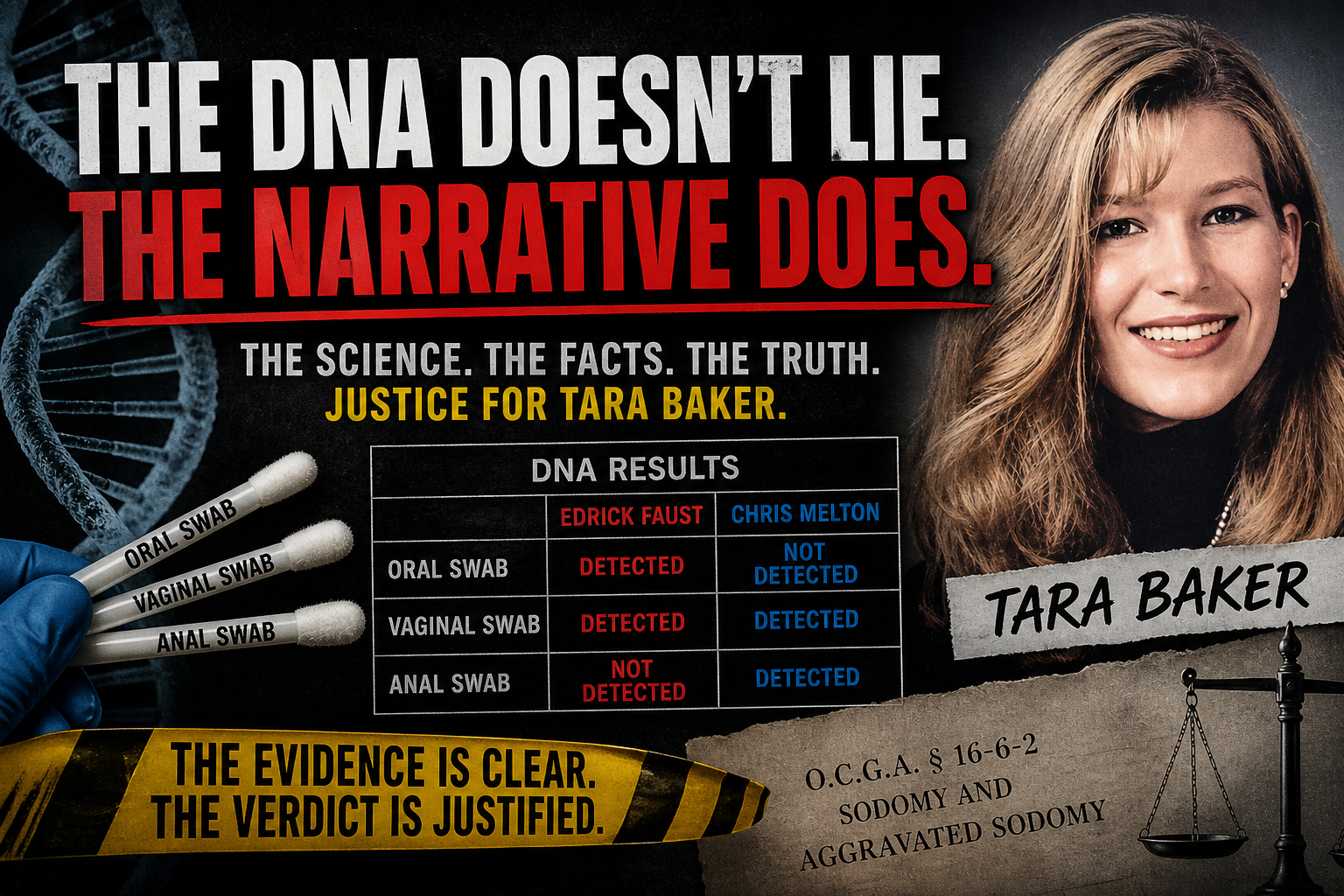
Edrick Faust was convicted of raping, sodomizing, and murdering Tara Baker. In the wake of that verdict, a steady stream of misinformation has followed, driven by a small but vocal group determined to cast doubt on the trial verdict. Their argument leans heavily on spreading misinformation about the forensic DNA evidence, and more pointedly, on the claim that the evidence somehow implicates Tara’s boyfriend, Chris Melton.
That claim collapses under a basic understanding of how DNA behaves in the human body.
What is being presented as suspicious is, in fact, entirely consistent with well-established forensic science. The patterns in the evidence do not point to an alternative suspect. They point to persistence, transfer, and timing, concepts that are fundamental to modern criminalistics but easy to misrepresent in isolation.
At some point, someone has to walk through the science carefully and plainly, not to argue a verdict, but to correct the record. Tara Baker and Chris Melton deserve that.
Locard’s Exchange Principle
The key to understanding the DNA evidence is a foundational forensic concept known as Locard’s Exchange Principle.
At its core, the principle holds that whenever two people or objects come into contact, there is a transfer of material between them. That transfer is almost never visible to the naked eye, but it is almost always there. It can include skin cells, bodily fluids, fibers, hair, or microscopic debris. Importantly, the exchange is two-way, but not necessarily equal. One surface may leave behind more than it takes, or vice versa.
What makes Locard’s principle so powerful, and sometimes misunderstood, is that it applies to every contact, not just major or obvious ones. Brief contact can still result in measurable transfer. Indirect contact can result in transfer. And material that is already present on one surface can be picked up and moved somewhere else.
That last point is critical. Locard’s principle does not just explain how a suspect leaves evidence behind. It also explains how existing material can be redistributed through subsequent contact. In modern forensic science, this is referred to as secondary transfer. A person can deposit DNA in a location they never directly touched, simply by carrying it from one place to another.
In other words, forensic evidence is not static. It moves, it degrades, and it accumulates over time based on contact, environment, and sequence of events.
That is why DNA evidence must be interpreted in context. Finding DNA in a particular location does not, by itself, answer how or when it got there. Locard’s principle tells investigators that the answer lies in understanding the chain of contacts that preceded it.
The DNA Evidence
During the trial, testimony established that Edrick Faust’s DNA was detected in Tara Baker’s oral and vaginal swabs, while Chris Melton’s DNA was identified in her vaginal and anal swabs.
For clarity, a “swab” is a sterile, cotton-tipped applicator used by medical and forensic professionals to collect biological evidence during a sexual assault examination. As part of a standardized rape kit, crime lab personnel swab specific areas of the body, such as the mouth, vagina, and anus, to recover biological material that may be present. Each area is sampled separately, packaged individually, and documented to preserve the integrity of the evidence and prevent cross-contamination.
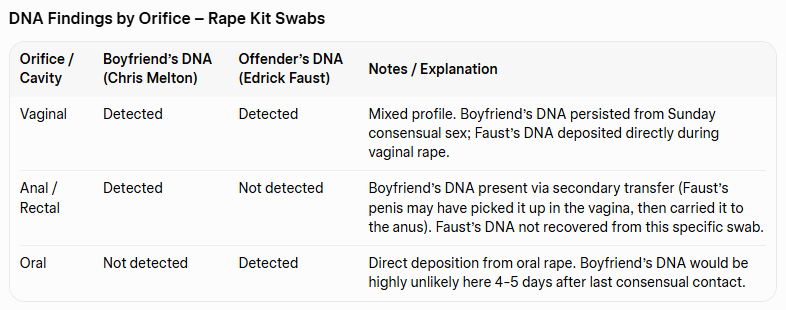
Tara Baker had consensual sex with Chris Melton approximately five days before Edrick Faust attacked, raped, and killed her. That timing matters. Forensic data shows that seminal DNA can persist in the vaginal cavity for up to seven days under normal conditions. At the time of Faust’s attack, residual DNA from the boyfriend would still be present.
During the attack, if the offender first penetrated the vagina, he would have come into direct contact with that residual biological material. Under Locard’s principle, that contact creates transfer. The offender can pick up trace amounts of previously deposited DNA.
If the assault then progressed to anal penetration, that transferred material can be carried and deposited into the anal cavity. This is secondary transfer. It is well documented in forensic science. It does not place the boyfriend at the scene. It shows that his DNA persisted and was subsequently moved.
Now consider a critical observation from the evidence: The boyfriend’s DNA was not detected in the oral cavity, but Faust’s DNA was.
That finding is not neutral. It is informative.
The oral cavity has the shortest DNA persistence window in the body. Saliva, enzymes, swallowing, and normal oral activity break down and remove biological material quickly. In most cases, foreign DNA is only reliably detectable for hours, and at the outer edge, up to roughly 24 to 48 hours under favorable conditions.
The boyfriend’s last sexual contact was approximately five days earlier. By that point, his DNA would not be expected to be present in the oral cavity. Its absence is entirely consistent with known science.
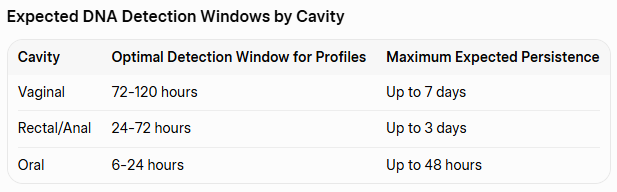
Faust’s DNA, however, is present in the oral cavity. That indicates recent, direct contact within that short detection window.
That contrast matters. It helps forensic scientists interpret sequence:
-
Faust’s DNA appears in the oral cavity because he had direct, contemporaneous contact there during the assault.
-
The boyfriend’s DNA does not appear there because it was never there or it was too old to persist in that environment.
-
The boyfriend’s DNA does appear in the anal cavity, not because of direct contact, but because it was picked up from a location where it could persist longer, the vagina, and then transferred during the assault.
That pattern is not random contamination. It is location-specific and time-dependent, which is exactly what forensic scientists look for when reconstructing events.
The next question is why the offender’s DNA would not appear in the anal swab.
There are several well-established reasons.
DNA does not deposit equally. Ejaculation is not required for penetration, and without it, the quantity of deposited DNA can be minimal.
Laboratory thresholds also matter. Forensic testing requires sufficient quantity and quality of DNA to generate a profile. It is entirely possible for DNA to be present but too limited or degraded to produce a reportable result, while another contributor’s DNA, originally present in greater quantity, is successfully detected.
So the scientific picture is coherent: DNA persists differently by location, transfers through contact, and degrades at different rates. When you look at all three cavities together, the pattern aligns with both biology and sequence of events, not contradiction.
It is not intuitive, but it is not unusual. This is exactly why forensic evidence must be interpreted in context, with attention to biology, timing, and sequence rather than in isolation.
What remains, once the disinformation is stripped away, is a pattern that is scientifically coherent and legally overwhelming. The DNA evidence does not point to an alternate suspect, and it does not undermine the conviction. It reflects exactly what forensic science predicts: DNA persists where it can, disappears where it cannot, and moves when contact allows it. When those principles are applied to the full body of evidence, not isolated fragments, the conclusions are not murky. They are clear, consistent, and aligned with the jury’s verdict: Edrick Faust raped and murdered Tara Baker. The attempt to reframe that evidence is not rooted in science. It is rooted in misunderstanding or willful distortion. Tara Baker and Chris Melton deserve better than that, and so does truth and justice.
On the Crime of Sodomy
Under O.C.G.A. § 16-6-2, a person commits sodomy when he or she performs or submits to any sexual act involving the sex organs of one person and the mouth or anus of another. Aggravated sodomy is that same act committed with force and against the will of the other person.
Two points are critical in applying this statute to the facts of this case.
First, sodomy encompasses both oral and anal acts. The law is not confined to a single anatomical site. Penetration of either the mouth or the anus satisfies the statutory definition.
Second, the statute does not require a DNA profile from any specific swab to prove that the act occurred. Criminal charges and convictions are based on the totality of the evidence, not a single forensic result. That evidence can include injuries documented at autopsy consistent with anal penetration, medical examiner findings, the presence of the defendant’s DNA in other anatomical locations such as the oral and vaginal cavities, and the overall sequence of events established by the investigation.
The absence of a detectable DNA profile from the offender in one particular sample does not establish that no sexual act occurred at that location. It means only that no usable DNA was recovered from that specific swab. Therefore, the fact that Edrick Faust’s DNA was not detected in the anal swab does not negate the charge or conviction for aggravated sodomy when the broader evidentiary record overwhelmingly supports that both anal and oral sodomy occurred.