In the crisp autumn air of Washington, D.C., where power brokers sip lattes and plot legacies, a symphony of demolition rattles the nation’s most scrutinized address. It is October 2025, and construction crews are tearing into the East Wing of the White House, long the home base for First Lady operations and social staff, as part of President Donald J. Trump’s grandest architectural flourish yet: a sprawling new ballroom. Estimated at roughly $300 million and said to span up to 90,000 square feet, the venue is designed to host as many as 999 guests in neoclassical opulence. The White House insists the funding is private, with major donors from the technology and defense worlds underwriting the project.
Yet as the dust settles and the excavators growl, another question arises from beneath the marble. Could this glittering addition also conceal upgrades to the Presidential Emergency Operations Center, the White House’s subterranean command bunker built for the worst-case scenario? To answer that, one must descend through layers of history, secrecy, and power.
Beneath the Columns: The Bunker Below
The Presidential Emergency Operations Center, or PEOC (pronounced “pee-ock”), lies directly beneath the East Wing. It is a hardened, self-contained shelter and command center, its reinforced concrete walls built to withstand nuclear blasts. Inside are secure communications, television feeds, phones, and briefing rooms that allow the president, vice president, and senior staff to coordinate national response during crises. Around-the-clock military officers man its consoles. Basic living quarters with fold-out bunks, food and water storage, medical supplies, and independent power and air systems permit occupants to remain underground for extended periods.
The PEOC’s origin dates to 1942, born of World War II panic after the attack on Pearl Harbor. President Franklin D. Roosevelt ordered the construction of a bomb-resistant shelter beneath the newly expanded East Wing, ostensibly built to house First Lady Eleanor Roosevelt’s staff. High fences hid the excavation while the public was told the work was merely an office renovation. The original bunker was modest: forty feet square, with seven-foot-thick walls, a diesel generator, and ramps to accommodate Roosevelt’s wheelchair. A tunnel linked it to a secondary shelter beneath the Treasury Building, providing an escape route. Though Roosevelt inspected it once, he never used it, preferring retreats such as the Maryland mountain camp later known as Camp David.
Over the next decades, the bunker evolved in lockstep with America’s anxieties. During the Truman-era gut renovation of the White House from 1948 to 1952, the facility was enlarged and hardened. President Eisenhower’s Cold War modernization further reinforced it to endure nuclear threats. In 2010, under President Obama, a $376 million “utility upgrade” project, officially for plumbing and electrical work, ignited speculation of a vast underground expansion, possibly descending five stories deep and capable of housing the entire West Wing staff. As in 1942, towering fences surrounded the work, and nothing visible changed above ground.
The PEOC in Action
Public glimpses of the PEOC are rare and usually come in moments of crisis. In the early 1970s, during anti-war demonstrations, Nixon officials used it as a secure observation post. Its most famous use came on September 11, 2001, when Vice President Dick Cheney, National Security Advisor Condoleezza Rice, and other senior officials directed emergency responses from within its reinforced walls. Declassified photos later revealed a utilitarian room with exposed pipes, fluorescent lights, and snacks scattered on a cluttered table, where tense faces stared at glowing monitors.
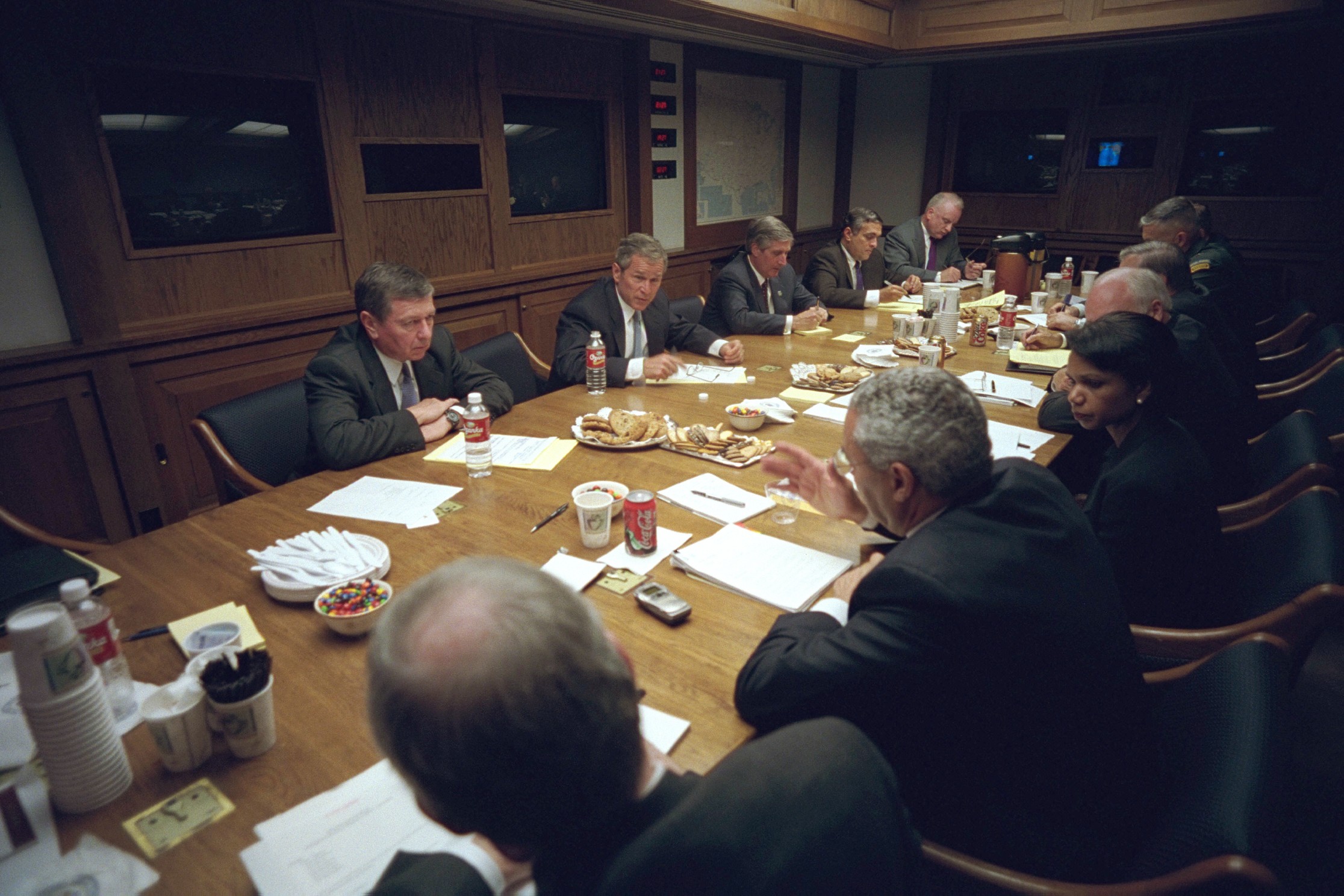
The bunker re-entered headlines in May 2020 when Secret Service agents escorted President Trump and his family there amid protests outside the White House. Trump later dismissed the incident as an “inspection” and demanded probes into leaks about his brief stay. Each episode reaffirmed the PEOC’s function as the last-resort nerve center of the presidency, invisible but indispensable.
After more than eighty years, modernization would hardly be surprising. The world of cyberwarfare, hypersonic missiles, and next-generation communications demands upgrades far beyond 1940s concrete and copper. What remains unknown is whether any such work is happening now, and whether the ballroom project provides the perfect cover.
The Ballroom Narrative Shifts
When the ballroom plan first surfaced this summer, Trump described the structure as “near [it] but not touching [it],” suggesting the East Wing would remain intact. But demolition began in earnest this week, with officials now acknowledging a full teardown and rebuild of the wing. The cost estimate ballooned to $300 million. Trump has brushed off preservation concerns, calling the East Wing “not historically significant.”
One persistent rumor, that Press Secretary Karoline Leavitt claimed “nothing will be torn down,” proved false. The Associated Press later corrected its reporting, noting the phrase came from a question, not from Leavitt herself.
Still, the process has drawn intense scrutiny. The administration initiated demolition before obtaining approval from the National Capital Planning Commission, the body that normally reviews all federal construction in Washington. Officials now promise to submit plans retroactively, but preservationists and lawmakers warn the move sets a dangerous precedent for one of the country’s most symbolic buildings. The National Trust for Historic Preservation cautioned that the proposed ballroom could overwhelm the White House’s delicate classical proportions and urged an immediate pause.
Meanwhile, questions swirl around the financing. Although labeled privately funded, the donor list reportedly includes corporate giants and wealthy individuals from the technology and defense sectors, raising concerns about influence, access, and the optics of remaking the People’s House through private patronage.
Reading the Signals Without Overreading Them
None of this definitively proves a secret PEOC renovation. Yet the convergence of factors, including the ballroom’s location directly above the bunker, the expanded scope of demolition, the procedural shortcuts, and the national security undertones, makes speculation unavoidable. The question is not whether something clandestine is happening, but whether the administration’s opacity invites public doubt.
At stake is more than marble and parquet. It is the principle of transparency at America’s most iconic residence, and the precedent it sets for presidential power over national heritage. If the ballroom is exactly what it appears to be, a lavish new event hall, then sunlight will only strengthen its legitimacy. But if beneath the chandeliers lies a fortified command center, the line between necessity and deception must blur once again.
When the curtain finally rises, will the nation see a monument to grandeur or a monument to secrecy, hidden beneath the dance floor?