If your flight is delayed, your paycheck frozen, your mortgage approval stalled, or your favorite national park closed, do not blame “Washington gridlock.” Blame the senators who voted “no” on H.R. 5371, the bill that would have kept the government open.
They had the power to prevent this shutdown. They were warned of the consequences. They voted against funding the government anyway. Their obstruction has furloughed hundreds of thousands of workers, crippled essential services, and cost taxpayers billions, all for political leverage.
The Bill They Killed
H.R. 5371, the Continuing Appropriations and Extensions Act, 2026, was as straightforward as legislation gets. It was not a partisan wish list or a spending binge. It was a clean continuing resolution that extended 2025 funding levels through November 21, 2025, giving Congress time to finish full-year appropriations.
The bill also extended vital programs for veterans, human services, healthcare, SNAP, hospitals that serve low-income communities, federal payrolls, etc. It was widely supported by business coalitions, local governments, and public-sector unions.
The House passed it on September 19, 2025, by a 217–212 vote. Then it went to the Senate, where 45 senators decided to kill it.
How the Shutdown Happened
From September 19 through October 16, the Senate held vote after vote on H.R. 5371. Each time, a bipartisan majority voted to fund the government. Each time, a block of at least 45 senators, mostly Democrats joined by two independents and a few Republicans, voted no and blocked progress.
Under Senate rules, most major bills require 60 votes to advance. That means just 45 “no” votes are enough to halt the government. That is exactly what they did.
They did not oppose the bill’s content; they opposed its simplicity. They wanted unrelated policy concessions, such as health insurance expansions and Medicaid changes, attached to the must-pass spending bill. When they did not get them, they pulled the plug on the entire federal government.
Senate Shutdown Scoreboard: How Close We Came
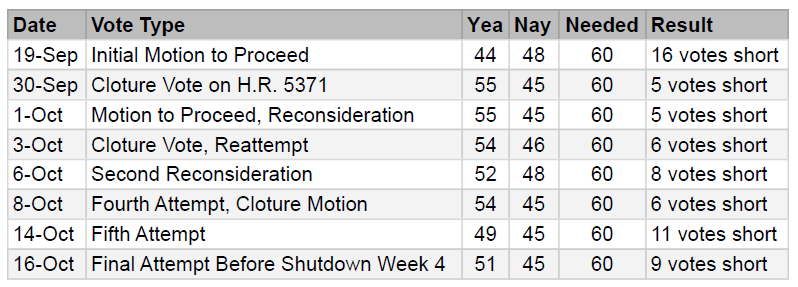
Bottom line: Every vote failed because of the “no” votes. Five changed minds could have kept the government open.
The Cost of Their Obstruction
The shutdown officially began at 12:01 a.m. on October 1, 2025, when funding expired. It is now entering its fourth week.
The consequences are mounting:
- 750,000 federal employees furloughed daily (CBO estimate)
- $15 billion in lost GDP each week (White House analysis)
- Delayed veterans’ benefits, food assistance, and federal aid
- Strained airports, shuttered parks, and halted infrastructure projects
This was not an accident. It was a deliberate political choice made by ~45 senators whose names you should remember.
The Senators Who Shut It Down
These are the senators who voted “no” on one or more H.R. 5371 votes, the ones who chose gridlock over governance, party over country, and ideology over paychecks.
Each of these senators cast at least one “no” vote on a bill designed to prevent this shutdown. Together, their obstruction froze the government in its tracks.
Five Votes Could End It Today
This crisis was not inevitable. It was intentional. The House did its job. Fifty-five senators have already voted yes. The shutdown continues only because 45 others refuse to move.
If five of them reversed course, the government could reopen within hours. There would be no need for new negotiations, only a new vote on H.R. 5371.
Every furloughed worker, every missed paycheck, every closed park, and every delayed benefit traces back to these votes. The shutdown is not abstract. It is personal, and it is preventable.
Hold Them Accountable
If one of these senators represents you, you have leverage. Their offices track every call, every message, and every constituent complaint. Tell them:
Vote YES on H.R. 5371. End the shutdown you caused.