In April 2013, in the small Romanian town of Segarcea in Dolj County, an ordinary family yard became the setting for a quiet catastrophe. A three-year-old boy, Gabriel Ruiu, had slipped and fallen nearly 50 feet into a narrow, covered well, a vertical shaft. What followed was not chaos, but something worse: a slow, grinding realization that the situation might be unsolvable.
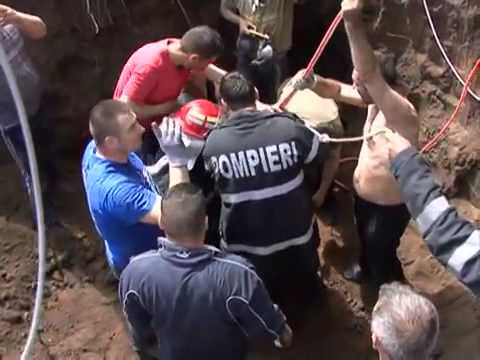
Firefighters and emergency crews arrived quickly. For more than eleven hours, they worked with relentless determination. They dug. They probed. They brought in heavy equipment. Every approach failed. The shaft was too tight, the soil too unstable, the margin for error too small. Time was running out. Hope followed.
At one point, a firefighter said aloud what everyone was thinking. There was no more hope.
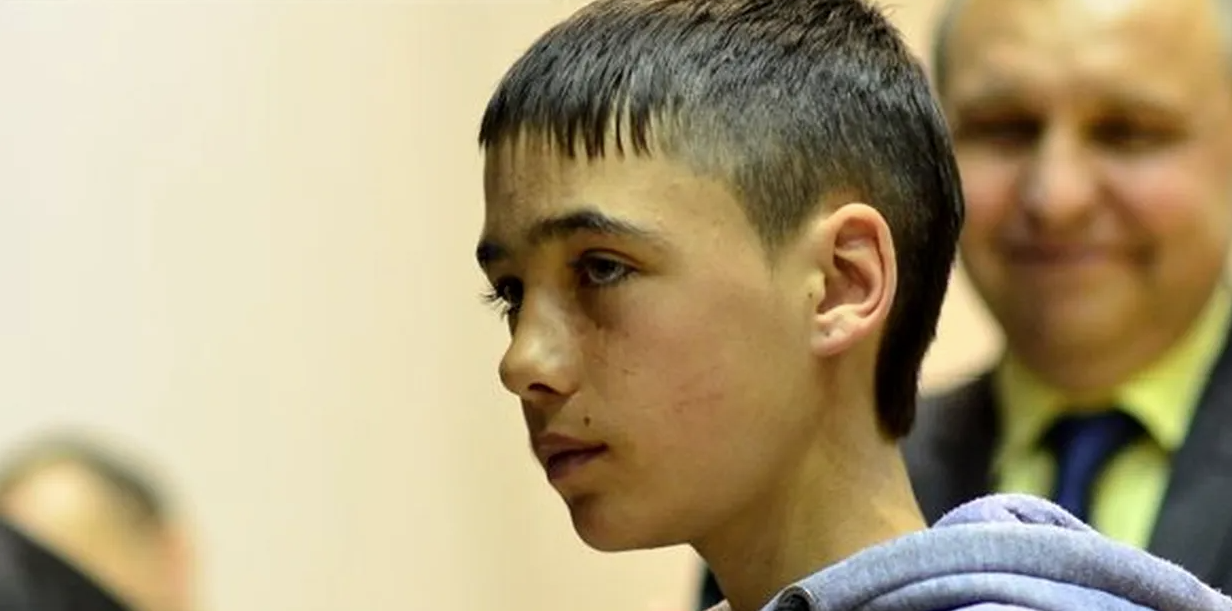
Then, from the edge of the crowd, a 14-year-old boy stepped forward.
His name was Cristian Marian Becheanu.
He was slight, young, and unremarkable in the way most teenagers are. But he had something no one else did: the ability to fit where no adult could. More importantly, he had the willingness to try.
The rescue team moved quickly. A headlamp was strapped to his forehead. A rope was secured to him. With coordination, they lowered him headfirst into the darkness.
Inside that narrow shaft, deep below the surface, Cristian reached the child. Gabriel was still alive, standing in cold water at the bottom. In that confined space, with no room for hesitation, the teenager took hold of him.
Above ground, the crowd waited in silence.
Then the rope tightened. Slowly, carefully, both bodies began to rise.
When Cristian emerged from the well with the child in his grasp, the tension broke. The crowd erupted. Gabriel was rushed to the hospital and made a full recovery.
Romania embraced its unlikely hero. Cristian was celebrated as “the saving angel” and “the bravest Oltenian.” Officials honored him at the Dolj County Prefecture. He received awards, gifts, and public recognition. But the most meaningful promise came from local leaders, who pledged to support his dream of becoming a firefighter. He was even awarded the emblem of Romania’s General Inspectorate for Emergency Situations, an honor no civilian had ever received.
Cristian did not let the moment define him. He let it direct him.
More than a decade later, he serves as Sergeant Major Cristian Marian Becheanu, a professional firefighter and rescuer with ISU Dolj. He is married. He has children. The boy who once descended into darkness to save a life chose to spend his own life doing the same.
What makes his story endure is not only the rescue itself, but what followed. A single act of courage became a pattern. A moment became a mission.
In a world that often questions whether one person can make a difference, Cristian Becheanu answered with action. He did not just save a child. He showed what it looks like to choose courage, and then choose it again.
Heroism as a Trait: Born, Made, or Both?
Heroism is often treated as something rare, almost mythical, as if it belongs only to a select few. Psychology tells a different story. Heroism is not a superpower. It is a pattern of behavior shaped by personality, perception, and circumstance.
At its core, heroism is simple to define and difficult to execute. It is the choice to act for others at personal risk, beyond what is expected.
Is Heroism a Personality Trait?
Research suggests that heroism is not driven by a single defining quality, but by a constellation of traits that tend to appear together.
Psychologists have identified what is sometimes called the “Great Eight” of heroic personality:
Quick thinking under pressure
Physical or mental resilience
Selflessness
Emotional durability
Reliability in crisis
The ability to inspire trust
Deep empathy
Moral courage
These traits overlap with broader personality frameworks, particularly the Big Five. Those who act heroically tend to score high in empathy, conscientiousness, and self-efficacy. They believe their actions matter, and that belief becomes decisive in moments where hesitation would otherwise prevail.
Heroism itself exists on a spectrum. There is what researchers call Big H heroism, high-risk acts that involve immediate danger to life, like entering a burning building or descending into a narrow well. Then there is small h heroism, quieter but no less important acts such as standing up to injustice or consistently choosing service over self-interest.
Both forms emerge from the same underlying traits. The difference is circumstance.
Nature, Nurture, or Something More?
The question of whether heroes are born or made does not yield a simple answer. Evidence points to both.
Biology plays a role. Studies suggest that some individuals are neurologically more sensitive to the suffering of others. Their brains respond more intensely to distress, making inaction psychologically uncomfortable. There is also evidence that fearlessness, a trait sometimes associated with risk-taking behavior, can be redirected toward altruistic ends.
But biology alone does not create heroes.
Environment, experience, and training are equally powerful. Psychologist Philip Zimbardo, through the Heroic Imagination Project, demonstrated that ordinary people can be taught to act courageously. When individuals learn to recognize social pressures, reframe fear, and see themselves as agents rather than bystanders, their likelihood of acting increases significantly.
Heroism, in this sense, is trainable.
It can be practiced in small ways. It can be reinforced by culture and role models. Over time, it can become habitual.
From a Moment to a Life
Cristian Becheanu’s story illustrates this interplay with unusual clarity.
At fourteen, he possessed certain advantages. His physical build allowed him to attempt the rescue. His instinctive courage pushed him forward. But those traits alone do not explain what came next.
Many people experience a single defining moment and move on. Cristian did not. He converted that moment into identity.
He became the thing he demonstrated.
That transition, from action to identity, is where heroism shifts from event to trait. It becomes not something a person does once, but something they are prepared to do again.
Why This Matters
Understanding heroism in this way changes the conversation.
If heroism were purely innate, it would be inaccessible. Reserved. Irrelevant to most people. But research suggests the opposite. The capacity for heroic action exists in far more people than we assume.
What varies is activation.
Situations matter. Training matters. Belief matters.
In everyday life, this translates into something practical. Heroism is not only about dramatic rescues. It is about cultivating empathy, practicing courage in small decisions, and building the confidence to act when it counts.
The lesson is not that everyone will face a moment like Cristian’s.
It is that everyone is capable of responding to their own moment when it arrives.
Cristian’s descent into that narrow well was a physical act. His ascent, and everything that followed, was something more enduring. It was the transformation of a single decision into a lifelong orientation toward service.
That is the real story.
Not that a boy saved a child.
But that he chose to become the kind of person who would do it again.
Choose to be a hero.
 ▶
Video loads from YouTube when you click play.
References
Allison, S. T. (2014, May 14). How heroic is your personality? Psychology Today. https://www.psychologytoday.com/us/blog/why-we-need-heroes/201405/how-heroic-is-your-personality
Allison, S. T., & Goethals, G. R. (2011). Heroes: What they do and why we need them. Oxford University Press.
Franco, Z., & Zimbardo, P. G. (2006). The banality of heroism. Greater Good, 3(2), 30–35. https://greatergood.berkeley.edu/article/item/the_banality_of_heroism
Glass, D. (2020, October 22). The bravest Oltenian. Doyle Glass Author. https://doyleglass.com/2020/10/22/the-bravest-oltenian/
Heroic Imagination Project. (n.d.). About us. https://www.heroicimagination.org/about-us
Keczer, Z., File, B., Orosz, G., & Zimbardo, P. G. (2016). Social representations of hero and everyday hero: A network study from representative samples. PLOS ONE, 11(8), Article e0159354. https://doi.org/10.1371/journal.pone.0159354
Sonne, J. W. H., & Gash, D. M. (2018). Psychopathy to altruism: Neurobiology of the selfish–selfless spectrum. Frontiers in Psychology, 9, Article 575. https://doi.org/10.3389/fpsyg.2018.00575
Verywell Mind. (2026, February 25). The psychology of heroism. https://www.verywellmind.com/the-psychology-of-heroism-2795905
Zimbardo, P. G. (n.d.). The psychology of heroism. Stanford Magazine. https://stanfordmag.org/contents/the-psychology-of-heroism