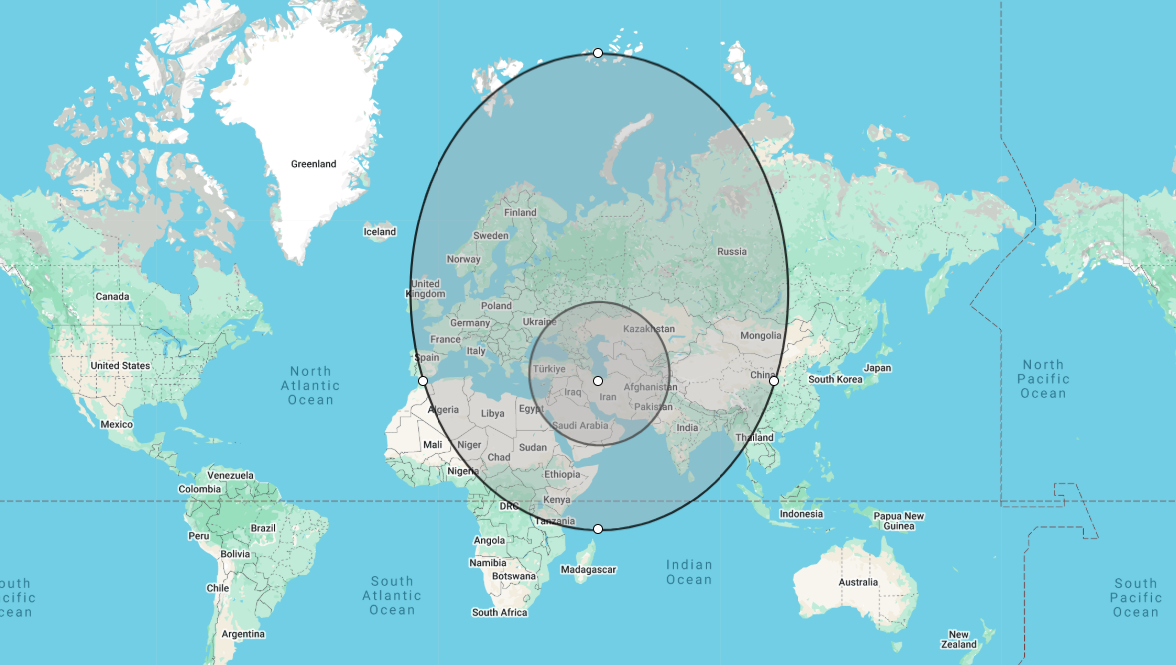
In the predawn hours of March 20, 2026, two Iranian intermediate-range ballistic missiles rose from mobile launchers somewhere in the Islamic Republic and climbed into the darkness. Their arc carried them not toward the familiar battlegrounds of Israel or the Persian Gulf, but southward over the Arabian Sea, then southeast across the vast emptiness of the Indian Ocean. The target was Diego Garcia, a speck of coral and concrete about 4,000 kilometers away. This joint U.S.-British base has long served as America’s unsinkable aircraft carrier in the Indo-Pacific. It houses B-52 bombers, nuclear submarines, and the logistical sinews of U.S. power projection.
Neither missile found its mark. One failed in flight and tumbled into the sea. The second was met by an SM-3 interceptor fired from a U.S. Navy warship. Whether the intercept succeeded remains classified. No damage occurred, and there were no casualties. On paper, this was a tactical failure. In reality, it was a strategic earthquake.
What Iran demonstrated was not precision or reliability. It was reach. In the world of deterrence, reach changes everything.
For decades, the world had operated on a comforting premise. Iran’s ballistic missiles stopped at roughly 2,000 kilometers. That was the self-imposed ceiling Tehran had repeated like scripture. It was the boundary baked into Western intelligence assessments, think-tank models, and military planning. It meant Iran could punish its immediate neighbors, including Israel, Saudi Arabia, and U.S. bases in the Gulf. However, it could not project credible power into the deeper oceans or the heart of Europe. That premise died with two streaks of fire over the Indian Ocean.
The Doctrine of the 2,000-Kilometer Limit
The story begins not with hardware but with messaging. Since the late 2010s, Iran’s supreme leader, Ayatollah Ali Khamenei, and his senior officials had insisted that their missile program was purely defensive and deliberately capped. Two thousand kilometers was enough, they said, to cover every threat that mattered: every Israeli city, every American outpost from Kuwait to Qatar, and every Saudi oil facility. Anything more would be provocative, unnecessary, and even destabilizing.
Foreign Minister Abbas Araghchi echoed the line as recently as February 2026. Iran had “deliberately limited” its missiles to 2,000 kilometers. The statement was not offhand. It was doctrine. For years, the world largely took Tehran at its word, at least as a description of what was actually deployed.
The hardware appeared to match the rhetoric. Iran’s arsenal was built on a foundation of reverse-engineered Scud missiles from the 1980s Iran-Iraq War. From there came the Shahab-3 (about 1,300 km), its more accurate cousins the Ghadr and Emad (1,700 to 2,000 km), the solid-fuel Sejjil (2,000 km), and the mysterious Khorramshahr series. Even the Khorramshahr, sometimes rumored to draw on North Korean technology, was assessed by most analysts at a combat-effective maximum of around 2,000 kilometers when carrying a full warhead. Longer shots were theoretically possible with lighter payloads, but no evidence suggested such weapons were operational.
Pre-strike assessments from the Center for Strategic and International Studies (CSIS), the U.S. Defense Intelligence Agency, Iran Watch, and the International Institute for Strategic Studies all converged on the same conclusion. Iran possessed the largest ballistic-missile force in the Middle East, but it was a regional force. No operational missile could reliably reach beyond 2,000 to 2,500 km. Space-launch vehicles offered a theoretical pathway to intercontinental range, but analysts projected a viable military ICBM no earlier than the mid-2030s. The map of Iranian power ended, more or less, where Iran said it did.
It was a reassuring boundary. Europe slept easy. American bases in the Indian Ocean and the Pacific felt untouchable. Deterrence calculations stayed manageable.
The Shot That Redrew the Map
Then came Diego Garcia.
The distance alone was astonishing. From Iranian territory to the atoll is approximately 4,000 kilometers, double the declared limit and deep into intermediate-range ballistic missile (IRBM) territory. Launching across open ocean at that range demands longer rocket motors, more sophisticated staging, better guidance over thousands of kilometers of flight, and reentry vehicles capable of surviving the extreme heat and stress of a full-range trajectory. It is not an incremental upgrade. It is a category shift.
U.S. officials, speaking to the Wall Street Journal, described the weapons explicitly as IRBMs, the first time Iran has used that class in combat. One missile suffered an in-flight failure, a reminder that long-range shots remain technically unforgiving. Yet the second traveled far enough, and accurately enough, to force an active intercept attempt by the U.S. Navy. In the context of an ongoing hot war with Israel and the United States, this was no parade stunt or laboratory test. It was an operational launch under fire.
For years, analysts had debated whether Iran could extend its reach through payload trade-offs or hidden variants. Now the debate collapsed: Tehran had shown it would. The self-imposed 2,000-kilometer ceiling was never a hard engineering limit. It was a political choice, one that Iran has now demonstrated it can discard when it chooses.
From Regional Menace to Trans-Oceanic Actor
The strategic geometry has shifted.
At 2,000 kilometers, Iran was a dangerous neighbor. It could saturate Israel with salvos, threaten Gulf shipping, and impose costs on any regional adversary. Its power radiated outward but remained bounded by geography.
At 4,000 kilometers, the boundaries dissolve. Diego Garcia itself, once prized for its isolation, now sits inside the threat envelope. Supply lines across the Indian Ocean, logistics hubs that underpin U.S. operations from the Middle East to the Pacific, and forward bases once considered safe rear areas all must now be reassessed. The U.S. and its allies will need to rethink dispersal, hardening, missile-defense layering, and the very architecture of power projection.
The implications stretch even further. Project a 4,000-kilometer radius outward from launch sites in western or northwestern Iran, and the map of Europe transforms.
Southeastern and Central Europe fall comfortably inside the new envelope. Istanbul, Athens, Bucharest, Sofia, Belgrade, Budapest, Vienna, Warsaw, Prague, and Berlin, cities once marginal or beyond practical reach, are now well within operational depth. Payloads can remain heavier. Accuracy requirements, while still challenging, become more feasible.
Western Europe sits at the outer edge but no longer beyond contemplation. London, Paris, Brussels, Amsterdam, and Rome are roughly 4,000 to 4,500 kilometers from plausible Iranian launch zones, depending on exact geography and warhead weight. These are not yet “easy” targets. Terminal guidance at maximum range remains Iran’s weakest link. However, in deterrence, possibility matters more than perfection. Even a low-probability threat forces planners to account for risk.
Europe is no longer a sanctuary theater. NATO’s rear areas, logistics nodes, and political capitals have entered the conversation that Israel and the Gulf states have lived with for decades. Missile-defense systems designed for forward deployment may need to stretch deeper into the continent. Alliance burden-sharing debates will grow sharper.
The Meaning of an Imperfect Failure
It is tempting to wave away the Diego Garcia salvo because the missiles missed. One broke apart. The other was challenged by American defenses. No crater appeared, and no headlines of devastation followed.
But that misses the point. Ballistic-missile programs do not spring into the world fully mature. The early American and Soviet ICBMs of the 1950s and 1960s were plagued by failures. What mattered was the demonstration that the physics worked and that the range was achievable under real conditions. Iran has now crossed that threshold in combat.
The message Tehran sent was calibrated: We are not what you thought we were. We have capabilities we chose not to reveal until now. Whether through modified Khorramshahr variants, new solid-fuel designs, or quiet assistance from partners, Iran has closed the gap between theoretical potential and operational reality faster than most analysts predicted.
Accuracy at 4,000 kilometers remains an open question. Terminal guidance, maneuvering reentry vehicles, and penetration aids will require further iteration. Yet deterrence does not demand a bull’s-eye on every shot. It demands the credible possibility of pain. Iran has supplied that.
The Road Ahead and the New Uncertainty
If the current conflict widens, the Diego Garcia launch may come to be remembered not as a one-off but as a prelude. Longer-range Iranian missiles compress timelines, expand target lists, and raise the stakes of escalation. U.S. force posture in the Indo-Pacific, already stretched, now faces new vulnerabilities. European capitals must grapple with threats once considered abstract. Gulf partners and Israel confront an adversary whose arsenal has grown both in quantity and in strategic depth.
None of this means Iran suddenly possesses reliable ICBMs capable of striking the American homeland, still roughly 10,000 kilometers distant. That threshold remains years away. But the old rulebook of 2,000 kilometers and no farther has been publicly and dramatically torn up.
Distance, once a reliable buffer, is now a variable. In the volatile arithmetic of deterrence and war, variables have a way of multiplying.
The missiles that arced toward Diego Garcia may have fallen short of their target. But they traveled far enough to redraw the map of power in the 21st century. The world is still absorbing the new contours.
References
BBC News. (2026, March 21). Iran launched unsuccessful attack on Diego Garcia. https://www.bbc.com/news/articles/c5yljdgwppzo
Center for Strategic and International Studies. (2026, March 3). Missiles of Iran. Missile Threat. https://missilethreat.csis.org/country/iran/
Center for Strategic and International Studies. (2024, April 23). Khorramshahr. Missile Threat. https://missilethreat.csis.org/missile/khorramshahr/
Center for Strategic and International Studies. (2024, April 23). Sejjil. Missile Threat. https://missilethreat.csis.org/missile/sejjil/
Holliday, S., & Dowell, A. (2026, March 21). Iran targeted Diego Garcia base with ballistic missiles. The Wall Street Journal. https://www.wsj.com/livecoverage/iran-us-israel-war-updates-2026/card/iran-targeted-diego-garcia-base-with-ballistic-missiles-rb7MdZW1CfwRTauDYHOt
Iran International. (2025, October 1). Iran says missile program not subject to limits. https://www.iranintl.com/en/202510015957
Landay, J., Pamuk, H., & Slattery, G. (2026, February 27). Trump’s claim on Iranian missile development said unsupported by US intelligence. The Times of Israel. https://www.timesofisrael.com/trumps-claim-on-iranian-missile-development-said-unsupported-by-us-intelligence/
Missile Threat Project, Center for Strategic and International Studies. (2017, November 1). Iran’s supreme leader limits ballistic missile range. https://missilethreat.csis.org/irans-supreme-leader-limits-ballistic-missile-range/
Reuters. (2026, February 27). Trump Iranian missile claim unsupported by U.S. intelligence, say sources. https://www.reuters.com/business/aerospace-defense/trump-iranian-missile-claim-unsupported-by-us-intelligence-say-sources-2026-02-27/
Reuters. (2026, March 20). Iran targeted but did not hit Diego Garcia base with missiles, WSJ reports. https://www.reuters.com/world/middle-east/iran-targeted-did-not-hit-diego-garcia-base-with-missiles-wsj-reports-2026-03-21/
U.S. Defense Intelligence Agency. (2025). 2025 worldwide threat assessment [Report]. https://www.dia.mil/Portals/110/Documents/News/golden_dome.pdf
U.S. Library of Congress, Congressional Research Service. (2026, March 6). U.S. military operations against Iran’s missile and nuclear programs (IN12665). https://www.congress.gov/crs-product/IN12665