

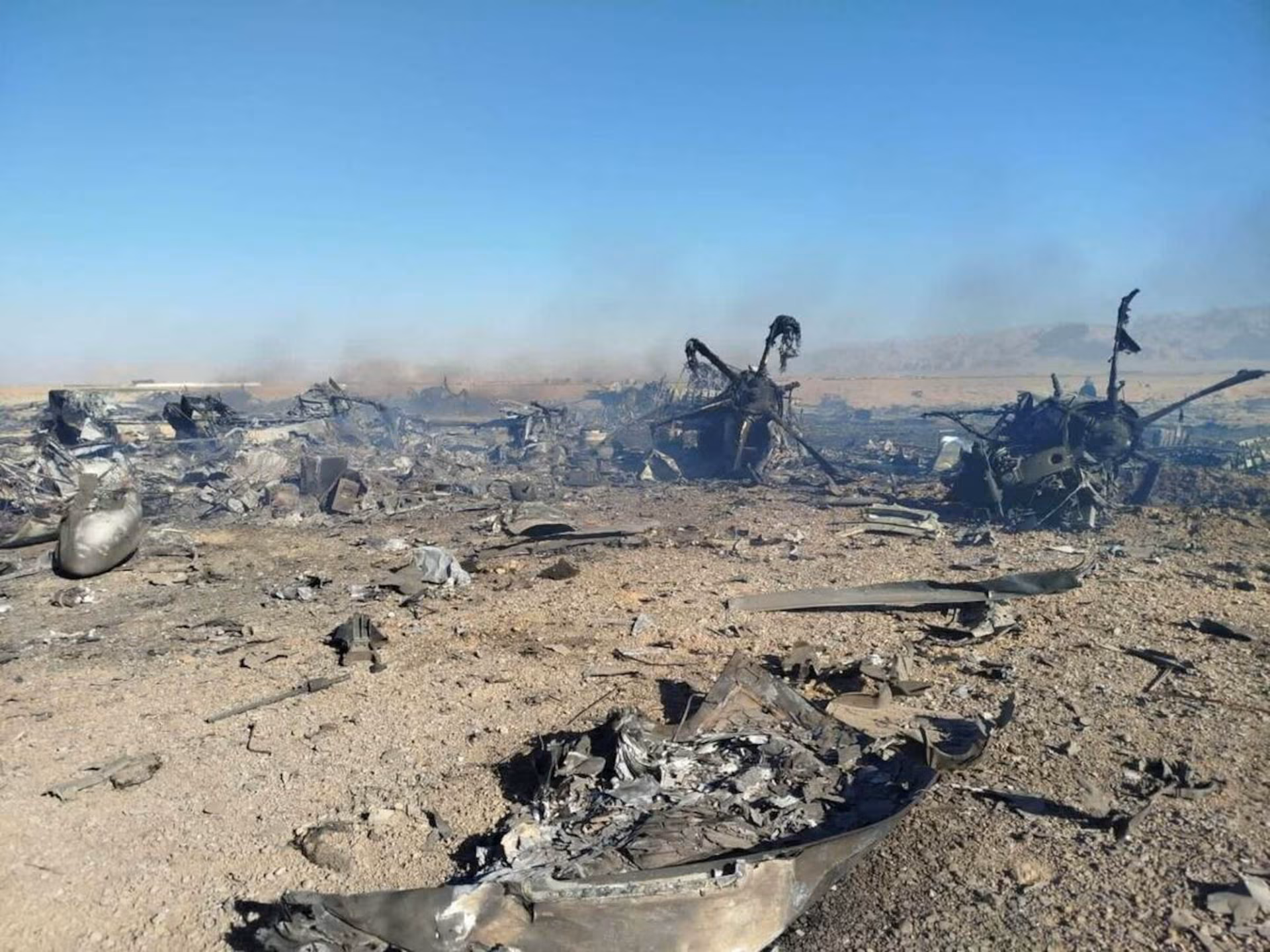
The footage is meant to be simple. Burned aircraft in the mountains of southern Isfahan. The carcass of C-130s, mangled and charred against the terrain. Iranian state television loops the images with the quiet insistence of a regime that understands the power of symbols. Look, it says. Look what we have done.
But symbols are treacherous things. They do not always mean what those who display them intend.
Because somewhere behind those images, beyond the frame and beyond the narrative, a more consequential story unfolded. It did not happen in front of cameras. It happened in the compressed, unforgiving space where time, risk, and judgment converge. And it reveals something far more enduring than wreckage.
It reveals what a nation chooses to save.
There is a tendency, in modern warfare, to reduce everything to capability. Platforms, payloads, range, survivability. We measure strength in tonnage and bandwidth, in sortie rates and strike counts. By those measures alone, the recent campaign has been staggering. Thousands of targets struck. Hundreds of sorties flown daily. A tempo of operations that would have been inconceivable a generation ago.
And yet, the most important decision in this entire episode was not technological. It was moral.
A downed American airman was on the ground inside hostile territory. Contrary to the breathless uncertainty that often surrounds these moments in public reporting, it is almost certain that U.S. forces knew where he was. Modern combat search and rescue is not guesswork. It is a fusion of encrypted communications, GPS beacons, overhead surveillance, signals intelligence, and the quiet persistence of analysts who turn fragments into certainty. The problem was not finding him.
The problem was getting to him.
He was injured. The terrain was unforgiving. The environment was hostile and actively contested. Time was not a luxury. Every hour increased the risk of capture, of exploitation, of a propaganda victory that would echo far beyond the tactical loss of a single airman.
So planners did what American planners have done, at their best, for decades. They built a solution that combined precision with audacity. Intelligence, cyber, space-based assets, air dominance, naval positioning, and the insertion of Tier 1 operators supported by a quick reaction force drawn from some of the most capable units in the world. Elements of the 75th Ranger Regiment, a Marine Expeditionary Unit, airborne forces staged in the region. A lattice of capability designed not for spectacle, but for effect.
And, if one reads the operation clearly, something else as well.
Deception.
Sun Tzu’s observation that all warfare is based on deception is not a relic of ancient theory. It is a living principle. The shaping of perception, the masking of intent, the misdirection of an adversary’s attention. Somewhere in the orchestration of this mission, that principle was almost certainly at work. Movements that suggested one objective while concealing another. Signals that obscured timing and intent. The quiet manipulation of an enemy’s expectations.
Not to impress. To buy time. To create space. To bring one man home.
And then something went wrong.
Aircraft that were meant to support the mission became immobilized. Whether by terrain, mechanical stress, enemy action, or some combination, they could not leave. In that moment, the operation could have collapsed into something far darker. History offers no shortage of examples where missions, once compromised, are abandoned, rationalized, explained away after the fact.
That did not happen here.
The operators on the ground made a decision that cuts to the core of this story. They destroyed their own aircraft. Not because they were defeated, but because they understood the hierarchy of value. The machines, however advanced, were expendable. The technology inside them, if captured, would have consequences. But even that was not the highest concern.
The highest concern was the people.
And so they chose to be stranded rather than compromised. Exposed rather than negligent. Dependent on a second wave rather than resigned to failure.
What followed is the part that should give every American pause, and, perhaps, a measure of quiet pride.
The United States went back.
More aircraft entered the same contested space. More risk was accepted. The mission expanded from a rescue to a rescue of the rescuers. And when it was over, every American came home.
No casualties. No one left behind.
In a campaign marked by relentless tempo, with thousands of strikes and sustained pressure across every domain, the losses, though limited in proportion to the scale of operations, carry a weight that should not be diminished. As of this writing, 15 American service members have been killed, more than 365 wounded, and at least seven aircraft lost in the confrontation with Iran. In another era, such costs would have fixed the nation’s attention. Today, they risk being absorbed into the sheer magnitude of events, their human significance softened by the scale of the story surrounding them.
Whatever else is inferred in the paragraphs that follow, one truth must remain untouched: these losses are real, and they are profound. Fifteen lives gone. Hundreds more altered in ways most will never fully see. Behind each number is a name, a family, a future that has been forever changed. No analysis, no strategy, no sense of national purpose should ever dull that reality. Before anything else, we should pause, with humility, to honor them and to pray for every life touched by these operations: the fallen, the wounded, their families, and all who now carry the quiet weight of what was given.
Buried within the numbers is something unique to the American volunteer service member. It is professionalism. Discipline. The cumulative result of decades of training, doctrine, and a culture that insists on excellence not as an aspiration, but as a baseline.
It is also sacrifice.
And that word, so often invoked, so often dulled by repetition, deserves to be understood in its proper weight. Sacrifice is not an abstraction. It is a series of decisions, made by individuals, to accept risk on behalf of others. It is the pilot who flies into contested airspace knowing the margin for error is thin. The operator who moves toward danger because someone else cannot move away from it. The planner who sends them, aware of the cost if something goes wrong.
It is, in its essence, the placing of the concept of human life and right above all else.
This is where the contrast between systems becomes unavoidable.
Authoritarian regimes are built, by necessity, on the preservation of the state. Their first instinct is to protect the image of strength, to maintain control, to ensure that the narrative of power remains intact. In such systems, individuals are often subsumed into the machinery of the state. Their value is measured in terms of utility, loyalty, and contribution to the system’s دوام (a Persian (Farsi) word that means durability, permanence, continuity, or endurance).
Democratic systems, at their best, attempt something more difficult. They assert that the state exists to serve the people, not the other way around. That its legitimacy derives not from its permanence, but from its protection of human dignity. That the ultimate measure of its strength is not what it can destroy, but what it refuses to sacrifice.
That ideal is imperfectly realized. It has been violated at times. It must be defended, renewed, and insisted upon by each generation.
But in moments like this, it is visible.
Aircraft are destroyed to protect lives. Additional risk is accepted to recover the vulnerable. Missions are extended not because they are easy, but because they are necessary.
This is not weakness. It is a different kind of strength.
And it arrives, this year, in a season that has long framed the same truth in a deeper register.
Easter does not celebrate preservation of the material. It does not exalt power as the world defines it. It centers instead on sacrifice, on the willing surrender of what cannot be reclaimed in order to redeem what can. It speaks to the idea that loss, when rightly ordered, is not final. That life is of such value it is worth everything.
You do not need to be a theologian to understand the resonance.
In those mountains, something was given up so that something greater could endure. What appeared, on a screen thousands of miles away, as destruction was, in fact, an act of preservation. Not of machines, but of men.
That is not resurrection. But it is a reflection of the same moral gravity.
And it should shape how we see not only this moment, but ourselves.
Because it is easy, in a divided age, to forget what binds us. To reduce the military to a political talking point, to view its actions through the narrow lens of faction rather than the broader lens of national identity. But there are moments that cut through that noise.
This is one of them.
Regardless of politics, Americans should be able to recognize what was accomplished here. Not as spectacle, not as propaganda, but as a demonstration of professionalism and commitment that makes the everyday freedoms of this country possible. The quiet reality that there are men and women who stand ready to do difficult, dangerous things on behalf of people they will never meet.
Freedom is not free. It never has been. It is purchased, daily, in ways both visible and unseen.
And it carries with it an obligation. Not only to support those who serve, but to remember what they are serving for. Not power for its own sake. Not dominance as an end. But the preservation of a way of life that places human dignity at its center.
It is also worth remembering, in the midst of all this, that the people of Iran are not the regime that governs them. They are heirs to a civilization of immense depth and beauty. They live under constraints they did not choose. They watch the same images, but through a different lens, shaped by pressures and narratives beyond their control.
They deserve more than to be cast as adversaries in a story they did not write.
So let this moment carry not only analysis, but hope.
A hope that one day, the distance between governments and their people will narrow. That dignity will not be mediated through coercion. That truth will not need to be filtered through state television. That the same value placed on human life in one system might, in time, find expression in another.
And so, on this Easter, as images of wreckage circle the globe, it is worth offering something quieter than commentary.
A prayer.
For those who have experienced sacrifice and loss, may they find comfort and new joy.
For those who fly into danger, may they may be kept safe and brought home.
For those who remain in harm’s way, may they may be protected.
For the people of Iran, may they know peace, freedom, and the fullness of their own humanity beyond the shadow of power.
And for all nations, when the moment of decision comes, they may choose wisely what is worth saving.
The metal will fade. The footage will be replaced. The narratives will shift.
But the measure of nations endures.
It is found in what they refuse to abandon.